

What You'll Need
Common Use Cases
Quick Path
Step-by-Step Setup
Advanced Automations
Quick Checklist
Troubleshooting & FAQs
Introduction
You’ve built your conversational AI agent on Irelia.ai, and it’s actively chatting with prospects on WhatsApp, Facebook, and Instagram. But what happens when something important occurs — like when a lead gets qualified, when your agent collects key information, or when someone books a meeting? Right now, you might be manually checking your Irelia dashboard and copying information to other tools. There’s a better way. This guide shows you how to automatically send information from Irelia to your other business tools the instant something important happens — no manual work, no delays, no checking dashboards. By the end of this guide, you’ll have: ✅ A working automation that triggers when important moments happen in your Irelia conversations✅ Data flowing automatically from Irelia to your CRM, spreadsheets, or team chat
✅ The knowledge to build unlimited additional automations
How This Works
Think of this connection like a smart doorbell system:📡 What Events Can Irelia Notify You About?
As your AI agent chats with prospects, Irelia tracks important milestones called events — the “moments that matter” in your conversations. Below are a few examples of Irelia events:📝 What You’ll Do
- 🔗 Get a webhook URL from Zapier — 3 min
- 📋 Paste the URL into Irelia — 2 min
- 🧪 Send test data — 2 min
- ⚡ Set up your action (Google Sheets, Slack, etc.) — 5 min
- ✅ Test everything end-to-end — 3 min
- 🚀 Turn it on and name it — 1 min
📋 What You’ll Need
- An Irelia.ai account with at least one active agent Required
- A Zapier account (free tier works fine) — Sign up here if needed Required
- A destination for your data (Google Sheets, Slack, or your CRM) Required
🎯 Common Use Cases
80% of readers need one of these two setups. Find yours, note the guidance, then follow the Step-by-Step Setup below — you’ll just make different selections at Step 2 and Step 4.- Update CRM on Qualification
- Push Collected Data
Lead Qualified or Goal AchievedWhich steps do I follow?- Contact already exists in your CRM or spreadsheet → Follow Steps 1–3, then use the Search & Update pattern for Step 4.
- Contact is brand new (not yet in your system) → Follow Steps 1–6 as written (Example A, B, or C in Step 4).
⚡ Quick Path (Experienced Users)
Already comfortable with Zapier? Here’s the condensed version:- Zapier: Create Zap → Trigger: “Webhooks by Zapier” → Event: “Catch Hook” → Copy webhook URL
- Irelia: Settings → Select Agent → Events and Notifications → Paste URL into desired event field
- Test: Click “Test” button in Irelia → Return to Zapier → Verify data received
- Action: Add your action app → Map fields → Test → Publish
🔧 Step-by-Step Setup
Step 1: Set Up Zapier to Receive Irelia Notifications
~3 minutes In this step, you’ll create a new and configure it to listen for events from Irelia.Create your Zap
- Log into your Zapier account at zapier.com
- Click the “Create Zap” button (top left or center of your dashboard)
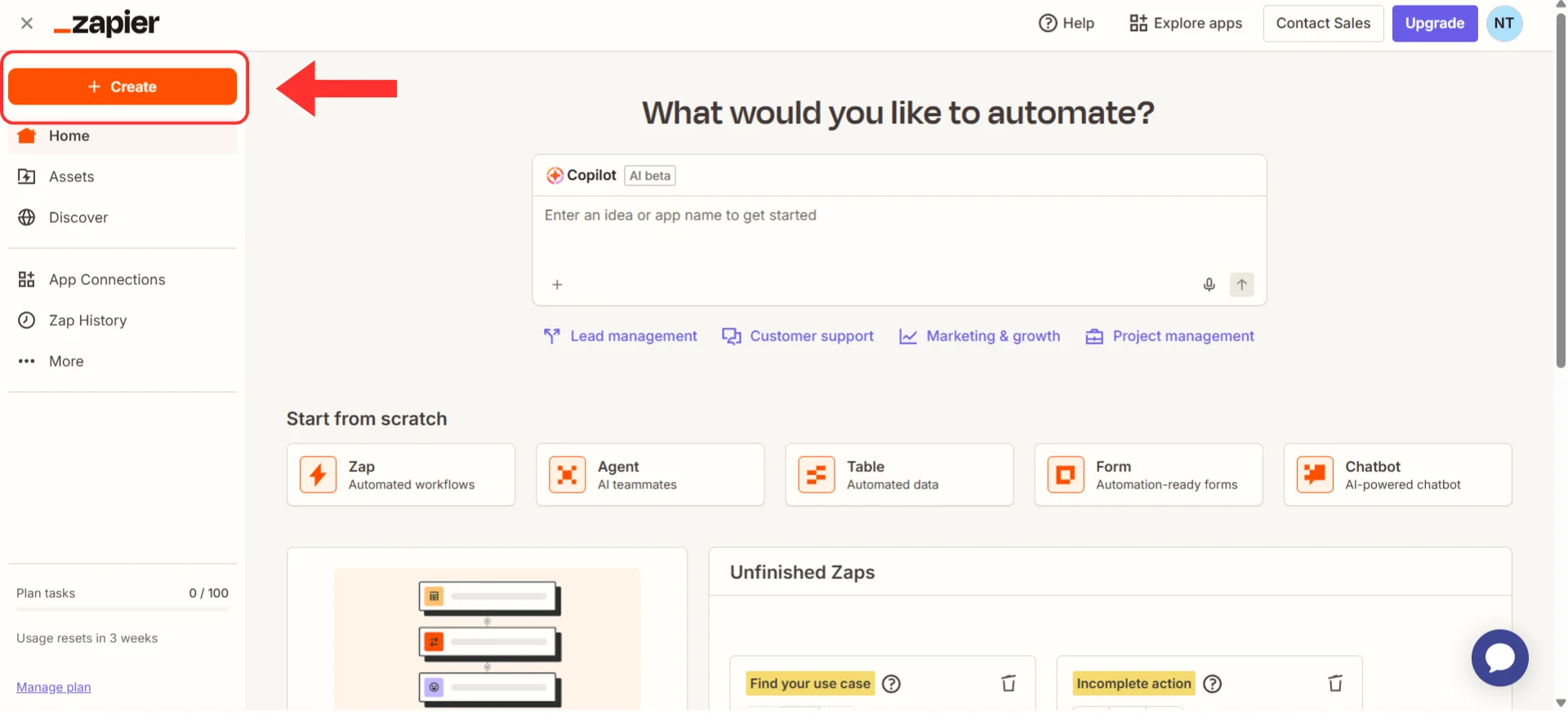
Click Create Zap to start building your automation
- You’ll see the Zap editor with two main sections:
- “Trigger” (what starts the automation) ← you’ll set this up now
- “Action” (what happens next) ← you’ll set this up in Step 4
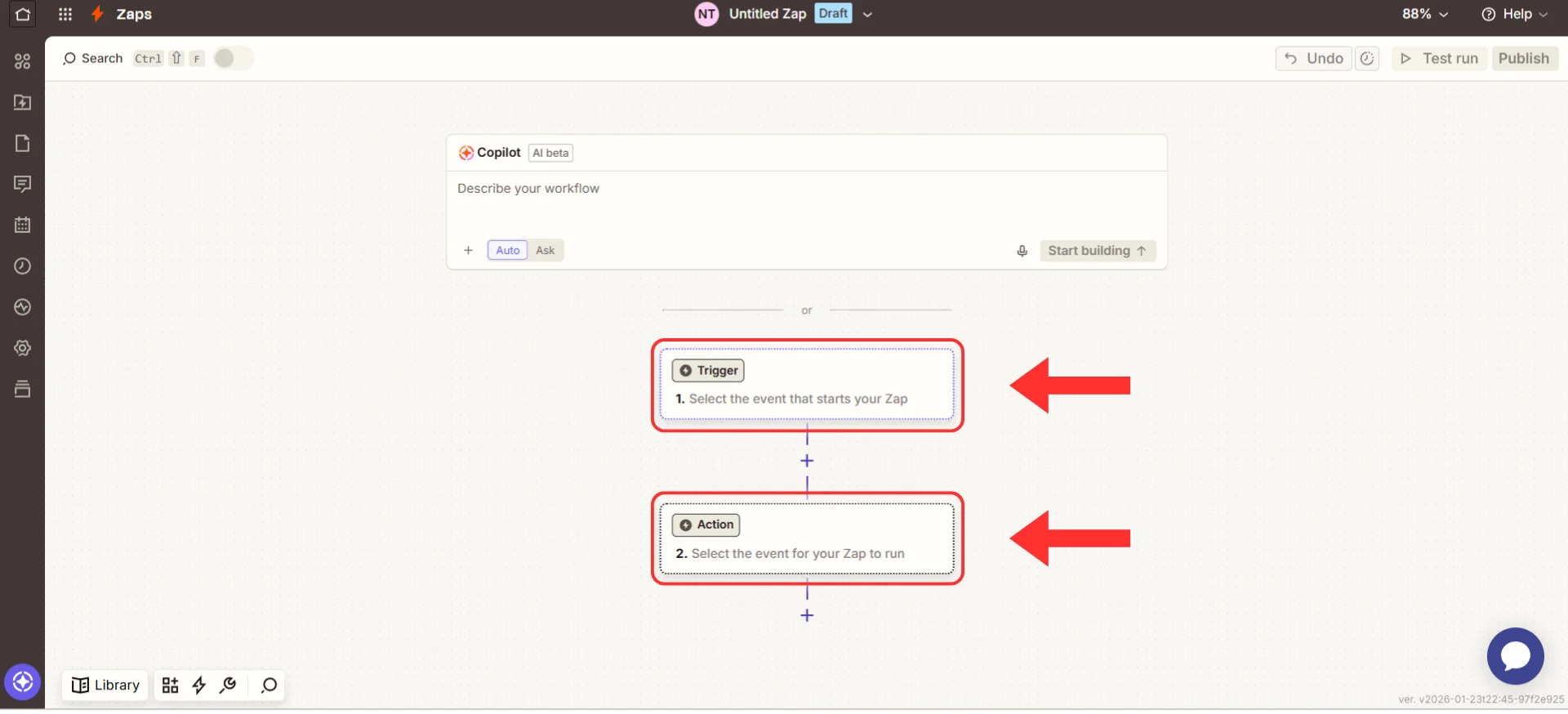
The Zap editor with Trigger and Action sections
Choose webhooks as your trigger
- Click the search box in the “Trigger” section
- Type
webhooksand select “Webhooks by Zapier”
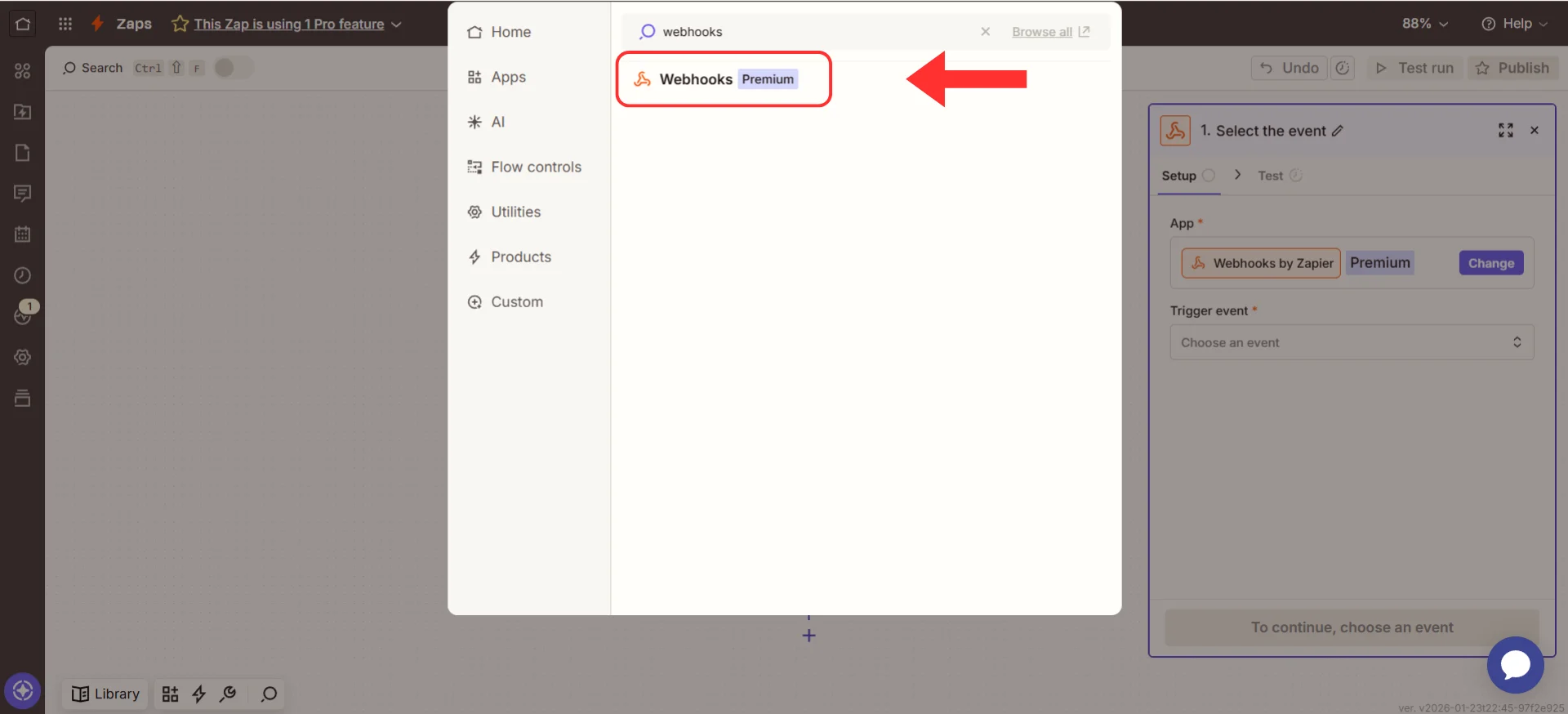
Search for and select Webhooks by Zapier
- For the “Event”, select “Catch Hook”
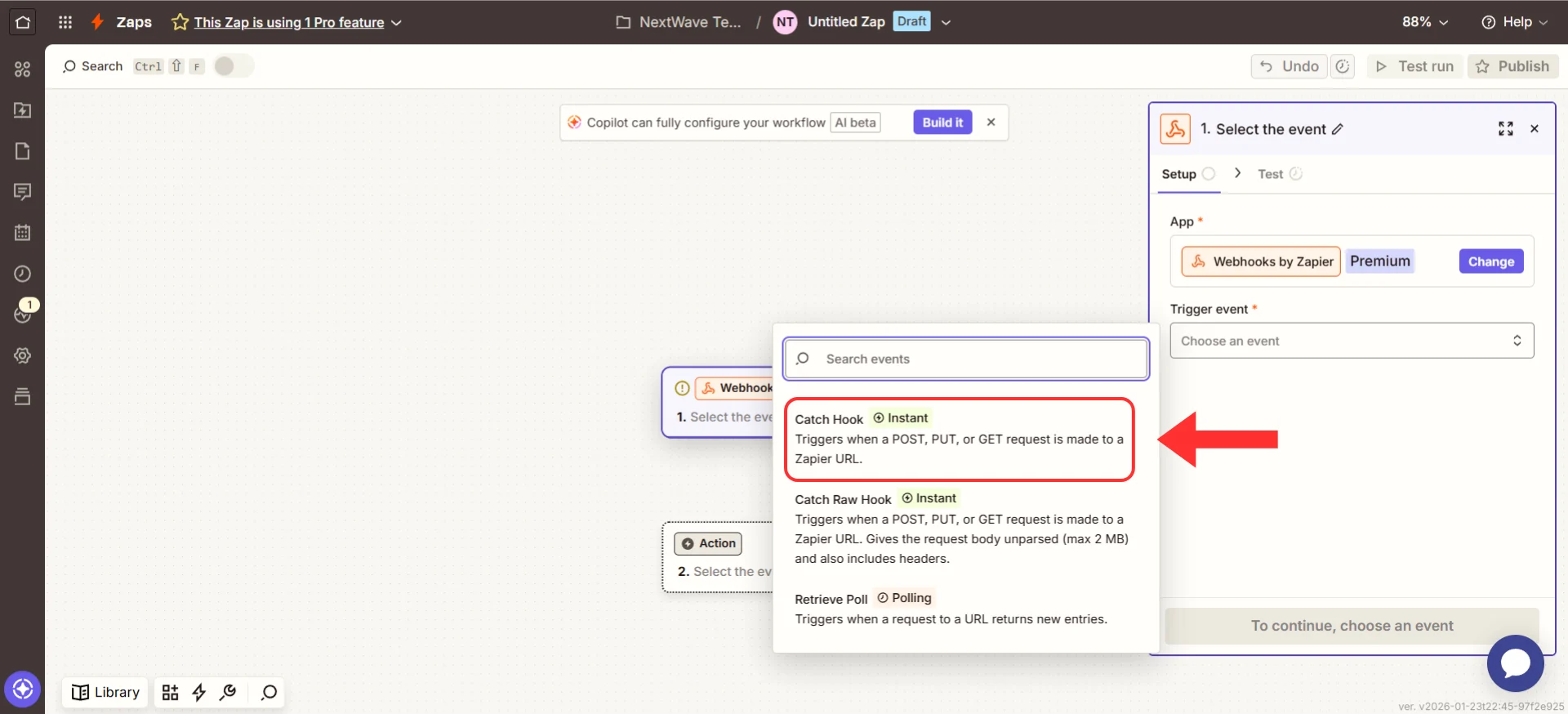
Select Catch Hook as the event type
- Click the “Continue” button twice (through the “Setup” and “Configure” sections)
Get your webhook URL
This is the most important part — you’re getting a unique URL that tells Irelia exactly where to send information.- Zapier will display a Custom Webhook URL that looks like:
https://hooks.zapier.com/hooks/catch/123456/abcdef/ - Click the “Copy” button next to the URL
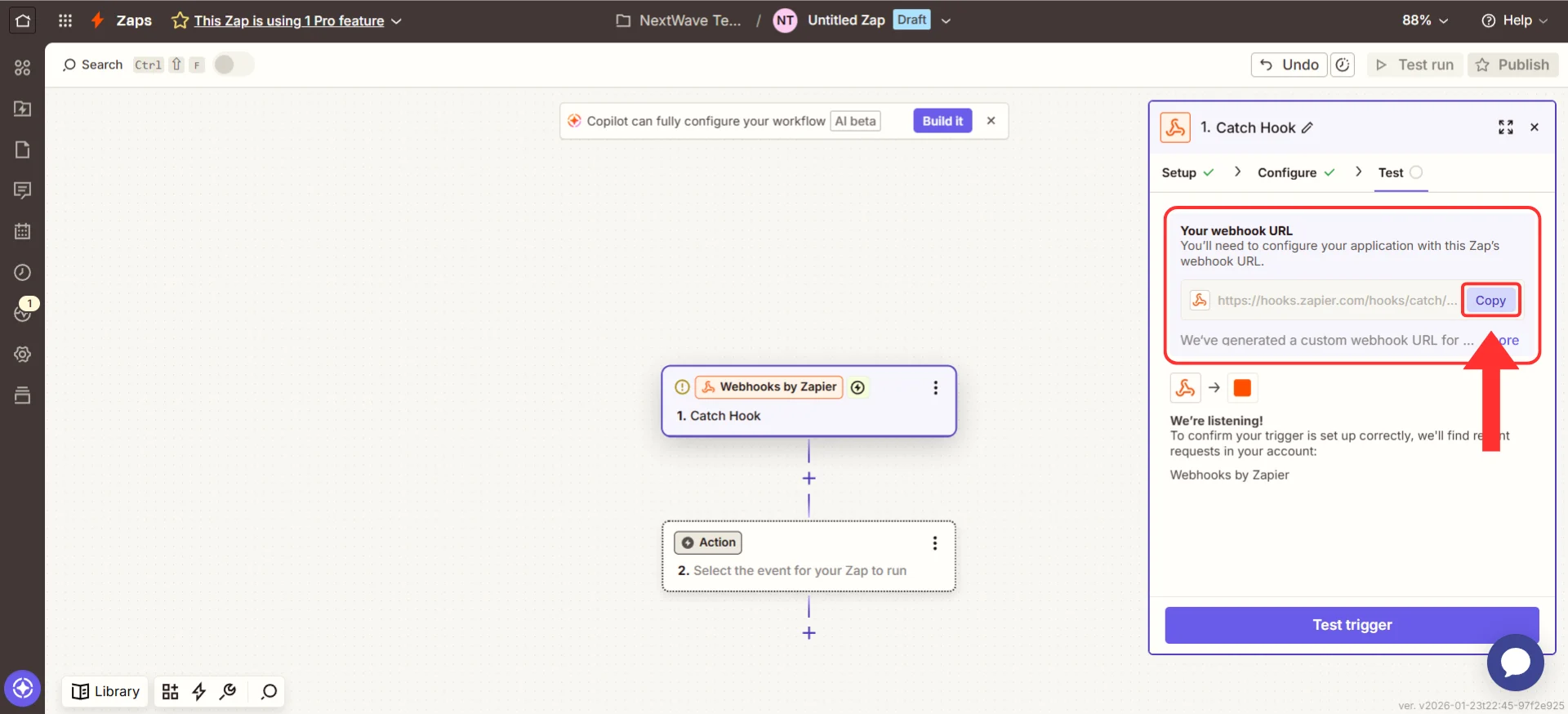
Copy the unique webhook URL to paste into Irelia
Step 2: Tell Irelia Where to Send Notifications
~2 minutes Now you’ll log into Irelia and paste the webhook URL you just copied.Access your agent settings
- Log into your Irelia.ai settings dashboard
- Select the agent you want to connect to Zapier
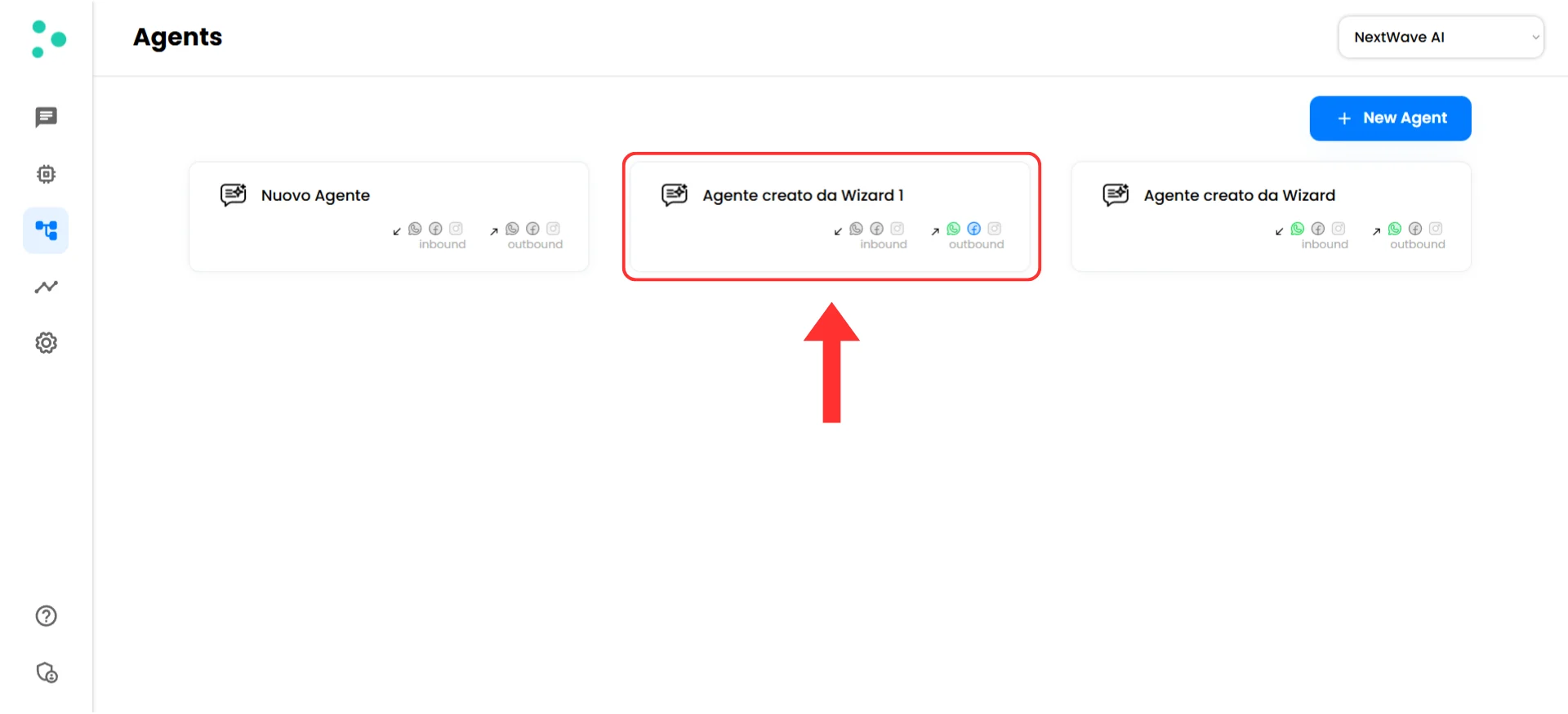
Select the agent you want to connect to Zapier
- Go to “Events and Notifications”
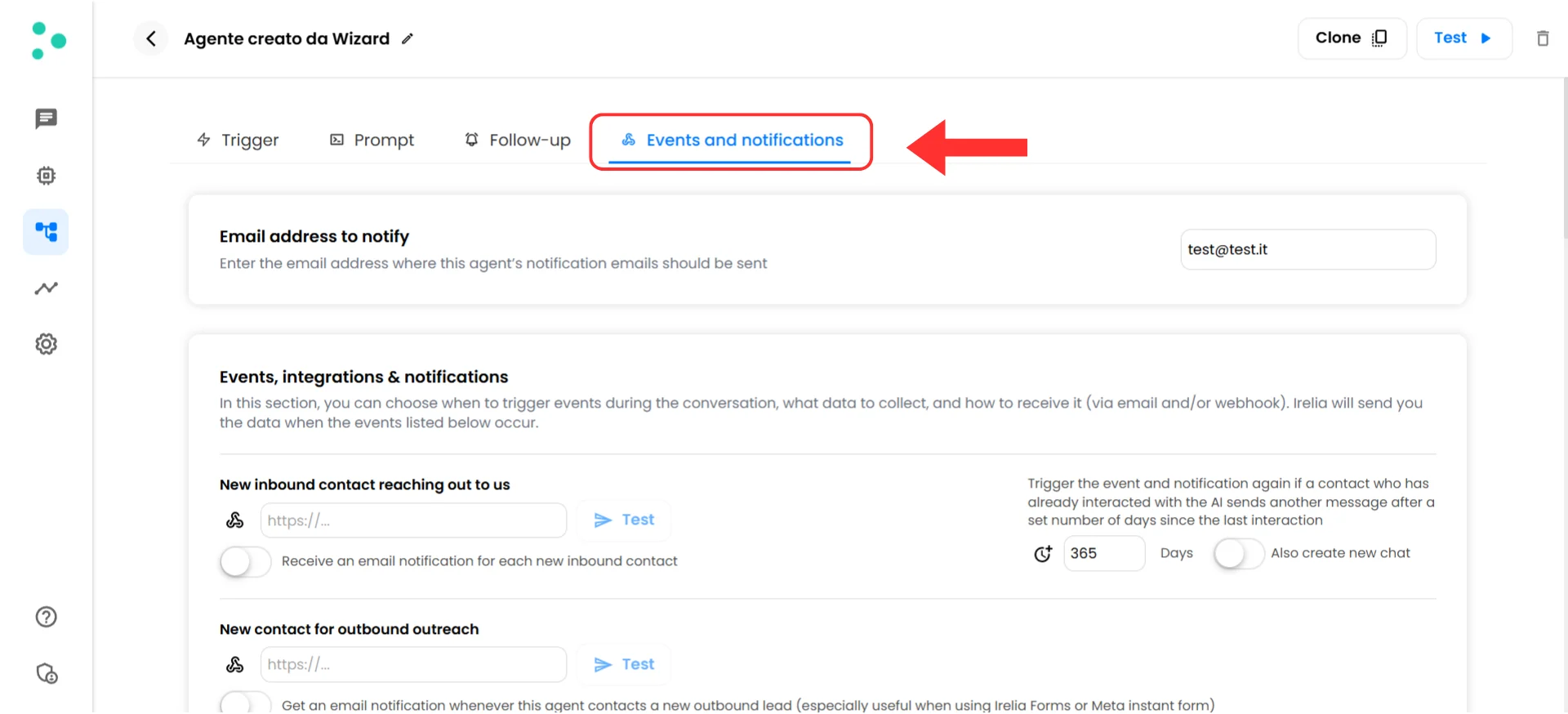
Navigate to Events and Notifications
Configure your webhook
- You’ll see a list of available events

The Events and Notifications panel with available events
- Find “New inbound contact reaching out to us” (or the event you want to configure)
- Click the “URL” field next to this event
- Paste the webhook URL you copied from Zapier (the URL will auto-save)
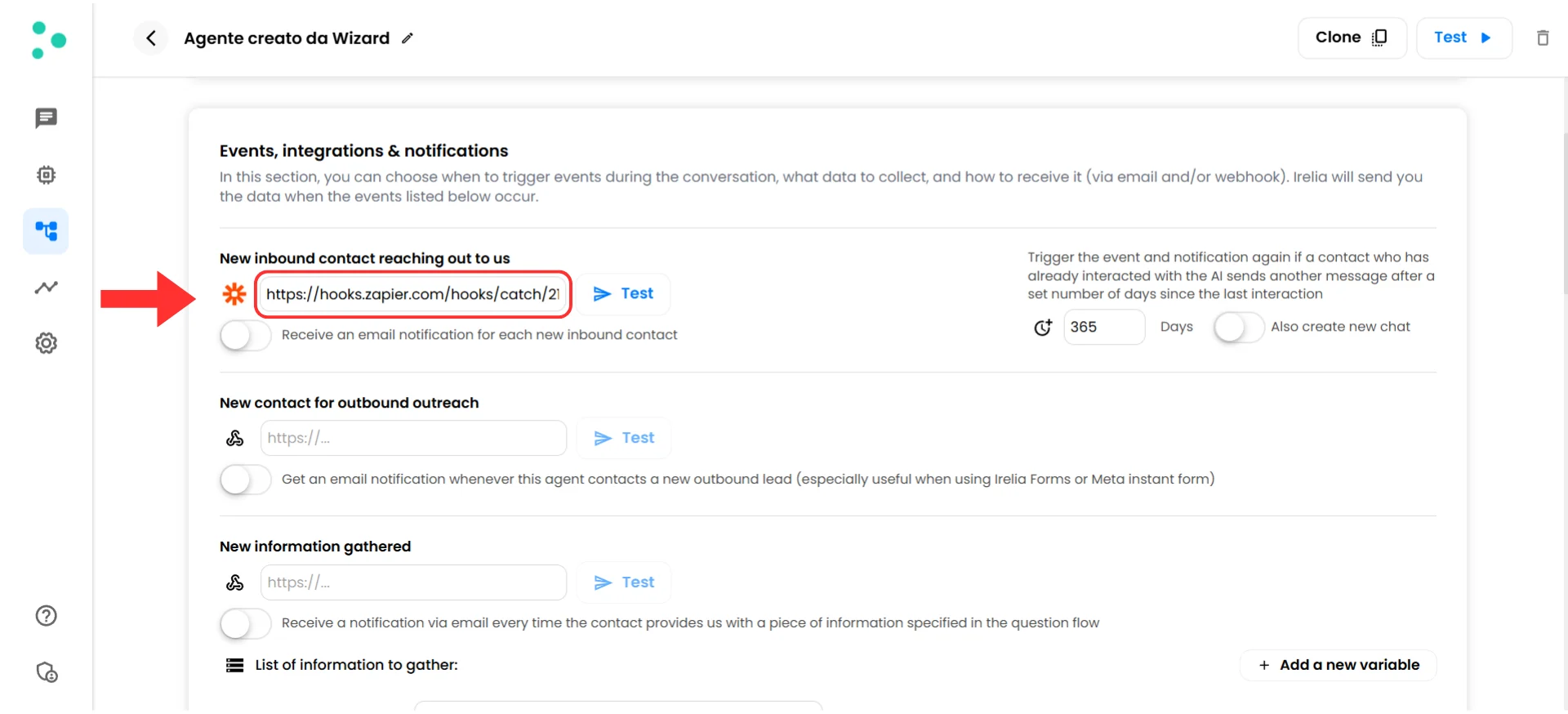
Webhook URL pasted with Test button visible
Step 3: Test the Connection
~2 minutes Now let’s verify that Irelia and Zapier can talk to each other.Send test data from Irelia
- In your Irelia webhook configuration (where you just pasted the URL), find the blue “Test” button next to the webhook URL field
- Click “Test”

Click Test to send sample data to Zapier
- You should see a green success indicator that says “Just sent a data sample successfully”
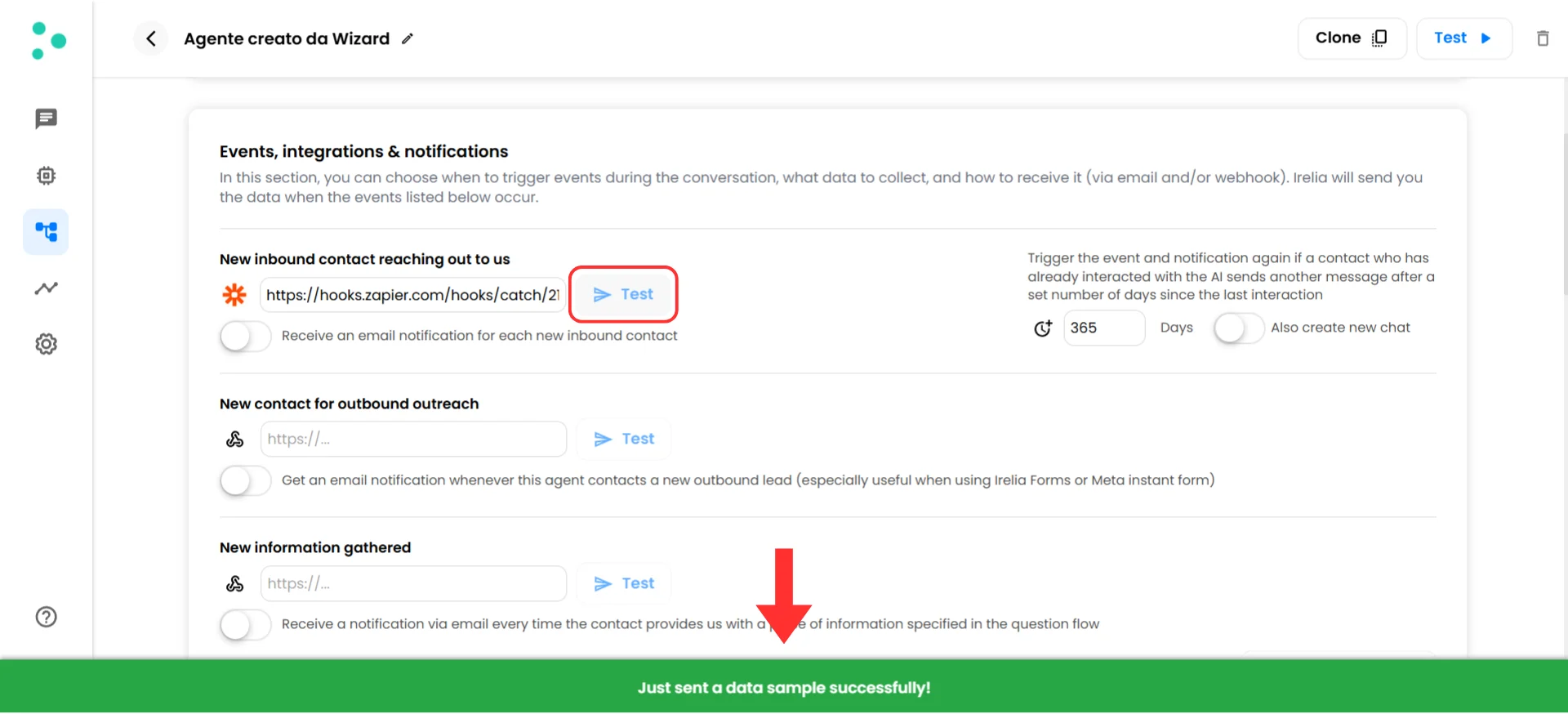
Green success confirmation after sending test data
Verify Zapier received the data
- Go back to your Zapier tab (the one you kept open)
- Click the “Test trigger” button to receive the data sample
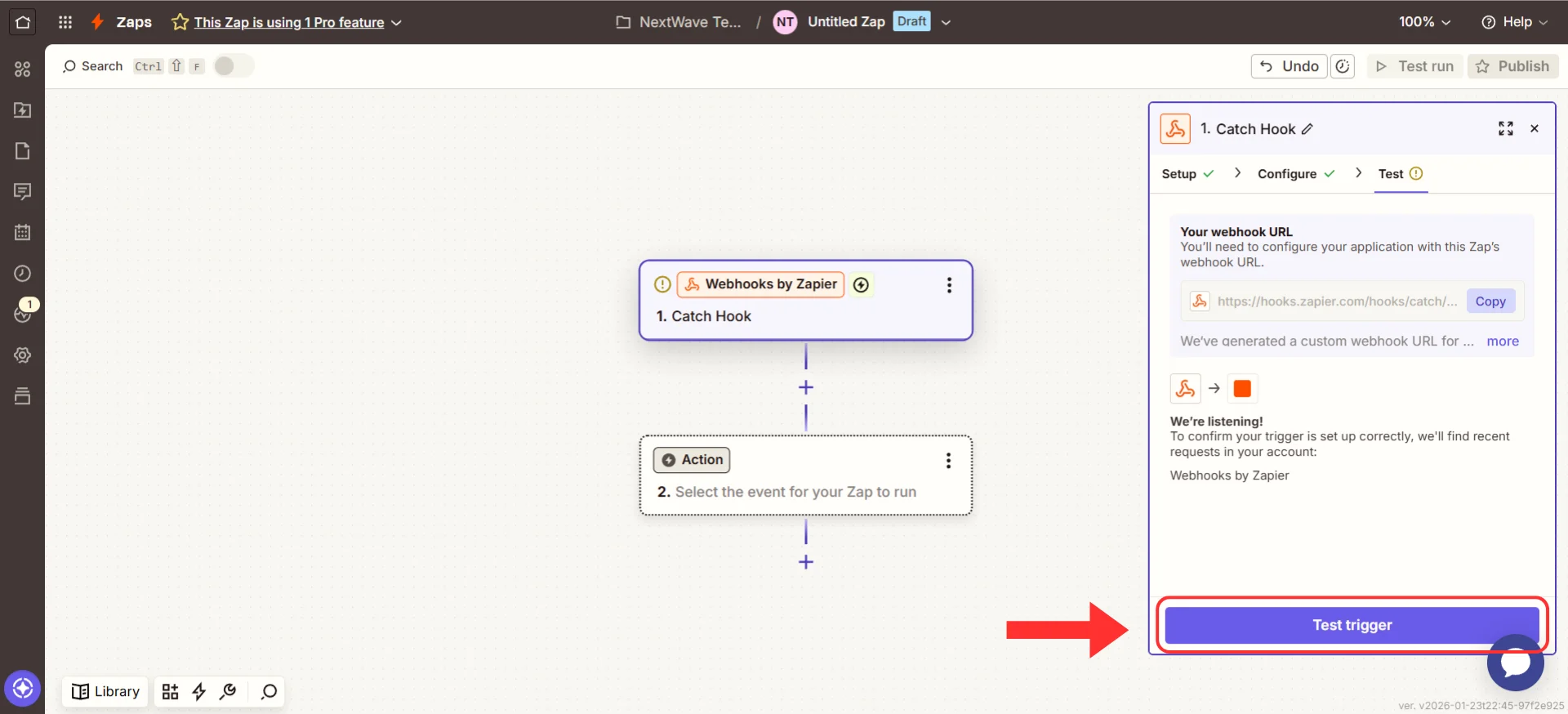
Click Test trigger to verify data received
- A list of data samples will appear — select one
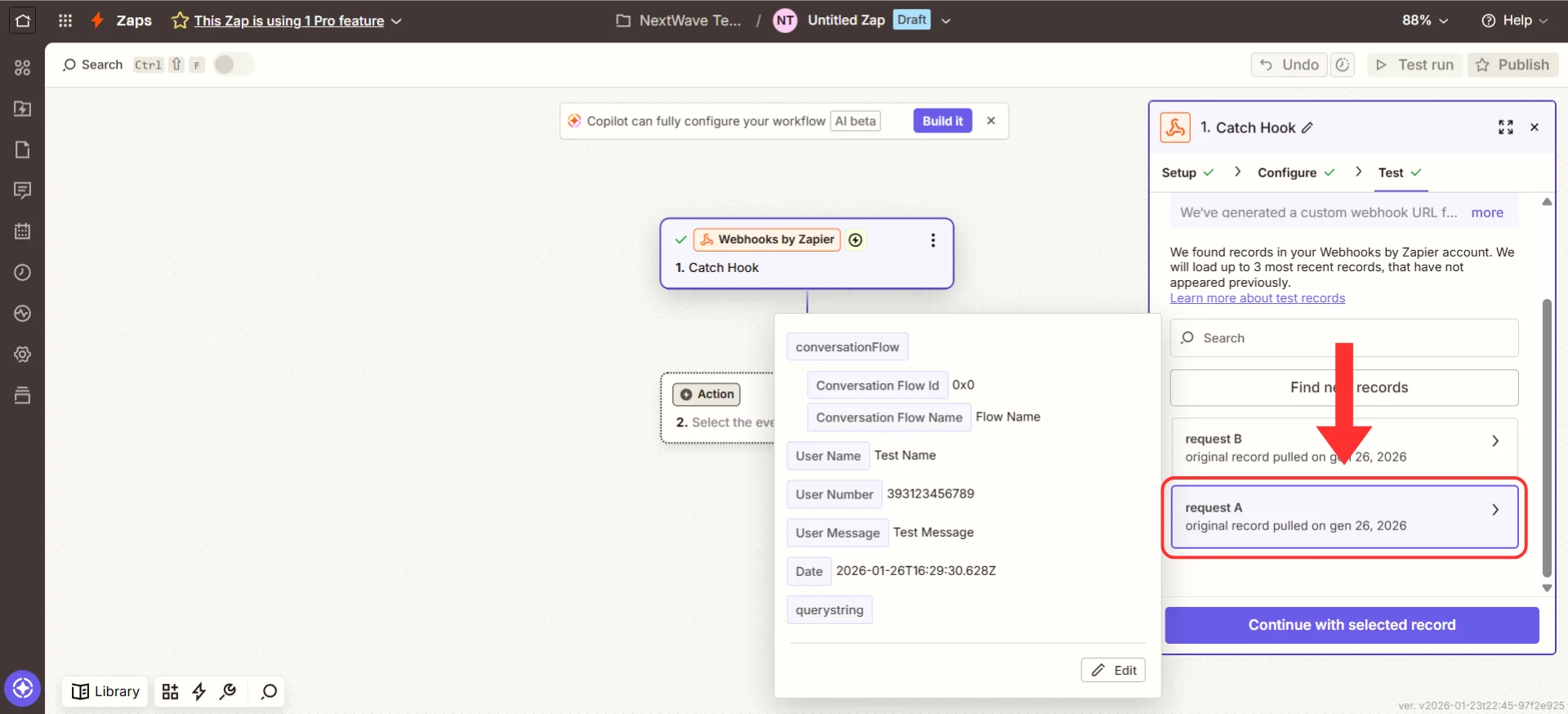
Select a data sample and click Continue with selected record
- Click the “Continue with selected record” button
Understanding What Irelia Sends You
Before setting up your action, take 60 seconds to understand what Irelia just sent to Zapier.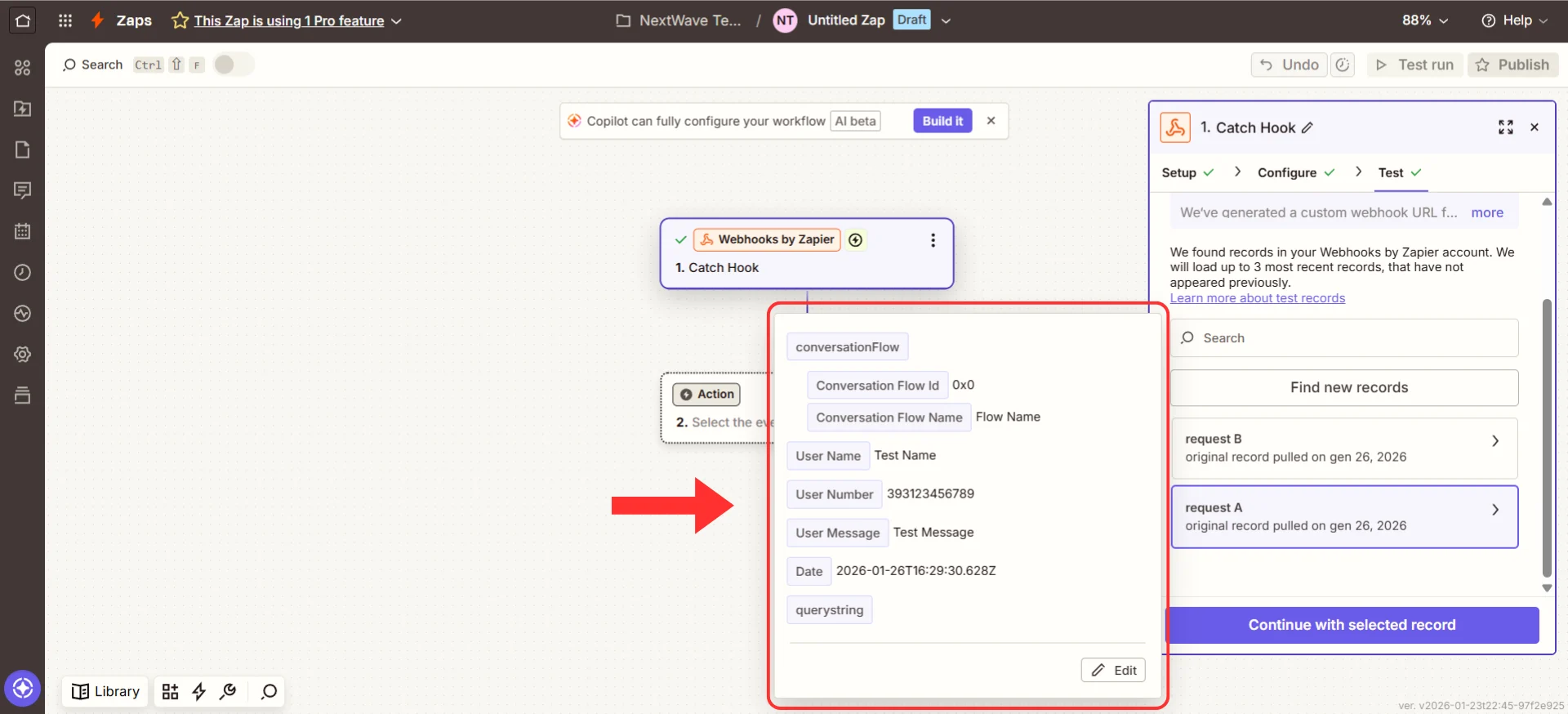
Complete webhook payload from Irelia with all available data fields
userName— The prospect’s nameuserNumber— Their phone numberinboundLead— Did they message first (true) or did you (false)?
conversationFlow section):
id— Unique agent identifiername— Name of the conversation agentchatHistory— Complete conversation transcript with this agentleadQualification— Are they qualified by this agent? ("fit","not a fit", or"TBD")interestScore— How interested are they? (0.0 to 1.0, like 0% to 100%)reasonNotQualified— Why they didn’t qualify (if applicable)goalAchieved— Number of goals completed with this agentnumberOfMessageSent— Messages sent by this agentnumberOfMessageReceived— Messages received from prospectnumberOfQuestionLackingData— Questions the AI couldn’t answer from the Knowledge BasecreditConsumedForThisChat— Credits used for this conversation
chatHistory— Complete chat history across all agentsoptStatus— Opt-in status (e.g.,"in","out")creditConsumedForThisLead— Total credits consumednumberOfMessageSent— Total messages sentnumberOfMessageReceived— Total messages receivednumberOfQuestionLackingData— Total questions lacking answersnumberOfGoalAchieved— Total goals achieved
customVariables— Specific information your agent collected (budget, company size, timeline, etc.)
name— What you asked about (e.g., “Budget”)value— Categorized answer (e.g., “$10k-50k”)valueRaw— Exact words they used (e.g., “We have around 30k to spend”)
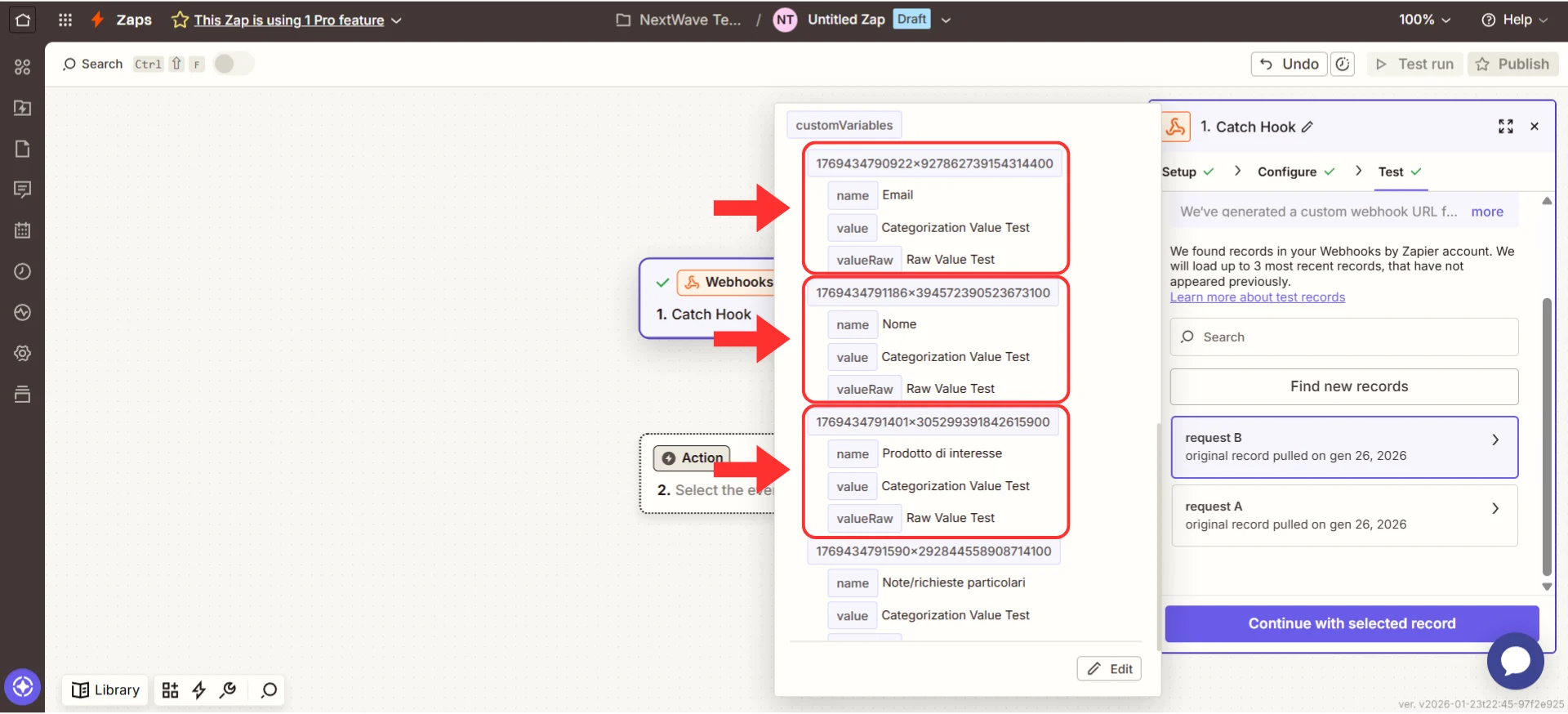
Custom variables with name, value, and valueRaw fields
Step 4: Set Up Your Action
~5 minutes Now comes the fun part: deciding what should automatically happen when Irelia sends data to Zapier.Choose your first action
Ask yourself: “When someone first contacts my agent, what’s the ONE most valuable thing that should happen automatically?” Common answers:- ✅ Log it immediately → Google Sheets (simplest, great for testing)
- ✅ Alert my team → Slack (immediate visibility)
- ✅ Add to my CRM → HubSpot, Salesforce, Pipedrive (most business value)
- ✅ Start a sequence → Email marketing tool (begins nurture process)
Example A: Log new contacts in Google Sheets
Recommended for first-timers- In the “Action” section, click the search box
- Search for and select “Google Sheets”
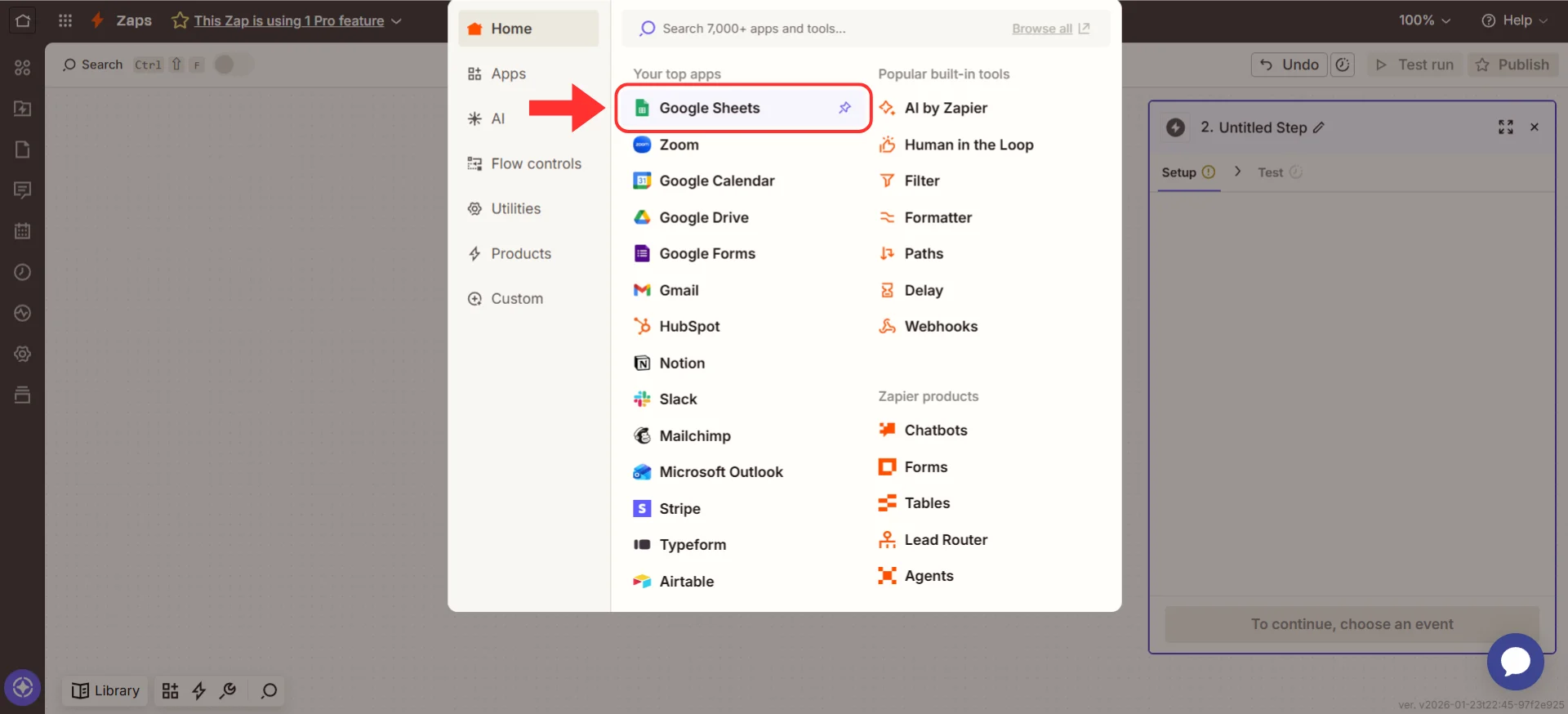
Select Google Sheets as your action app
- Choose “Create Spreadsheet Row” as the event
- Click the “Continue” button
- Connect your Google account (click “Sign in” and follow the prompts)
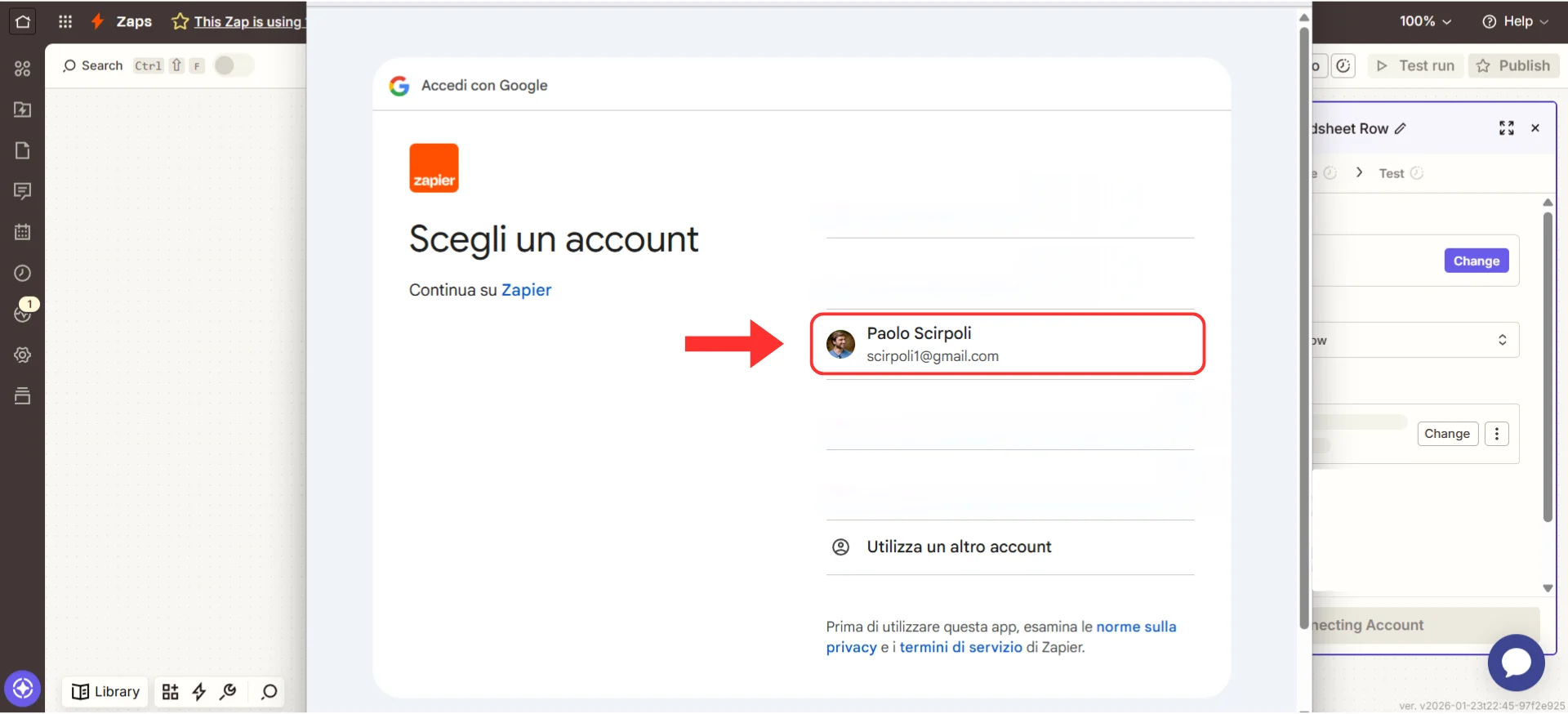
Sign in to your Google account to grant Zapier access
- Select your “Spreadsheet” (or create a new one first)
- Select your “Worksheet” (usually “Sheet1”)
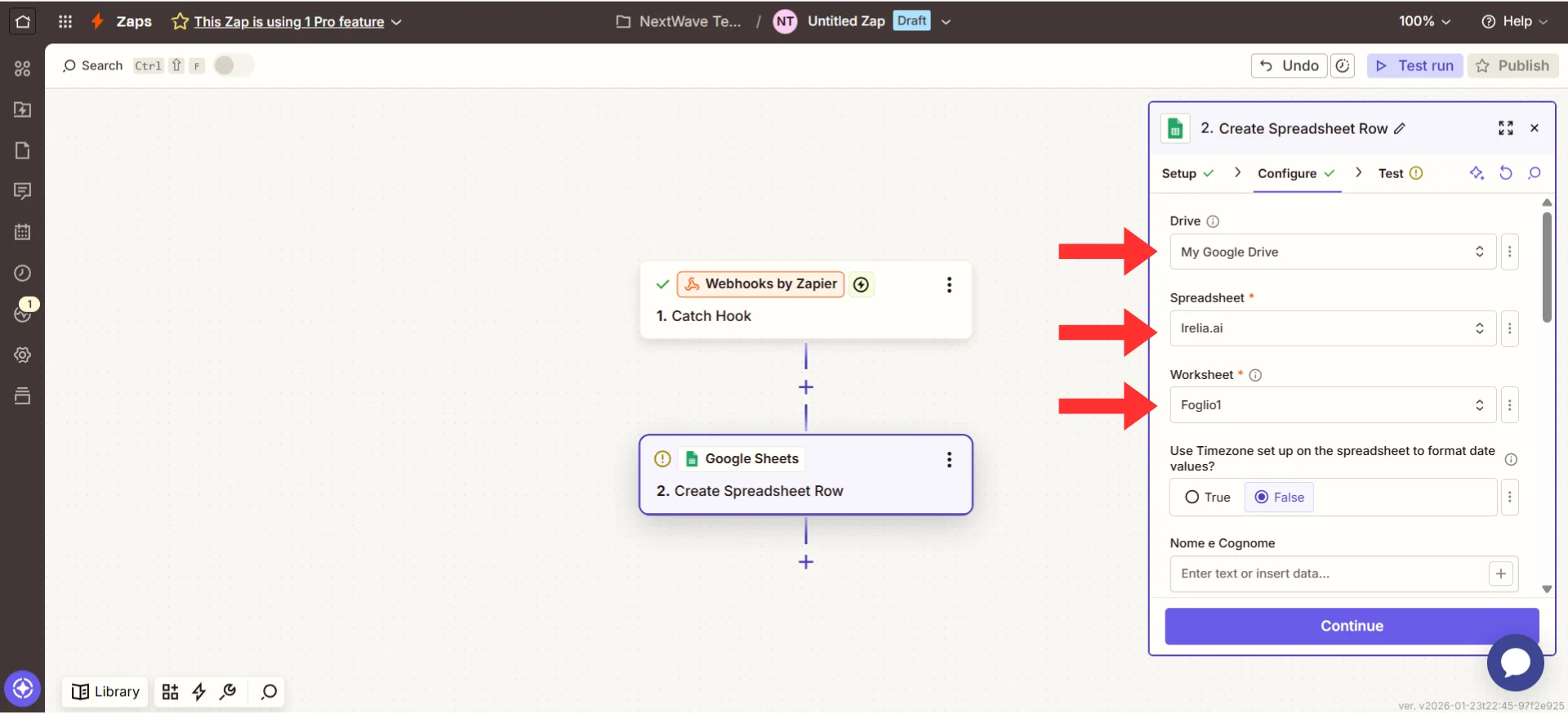
Select your spreadsheet and worksheet
- Map your fields — this is where you tell Zapier which Irelia data goes into which spreadsheet column. Click into each field, and Zapier will show you all available data from Irelia. Select the one you want.
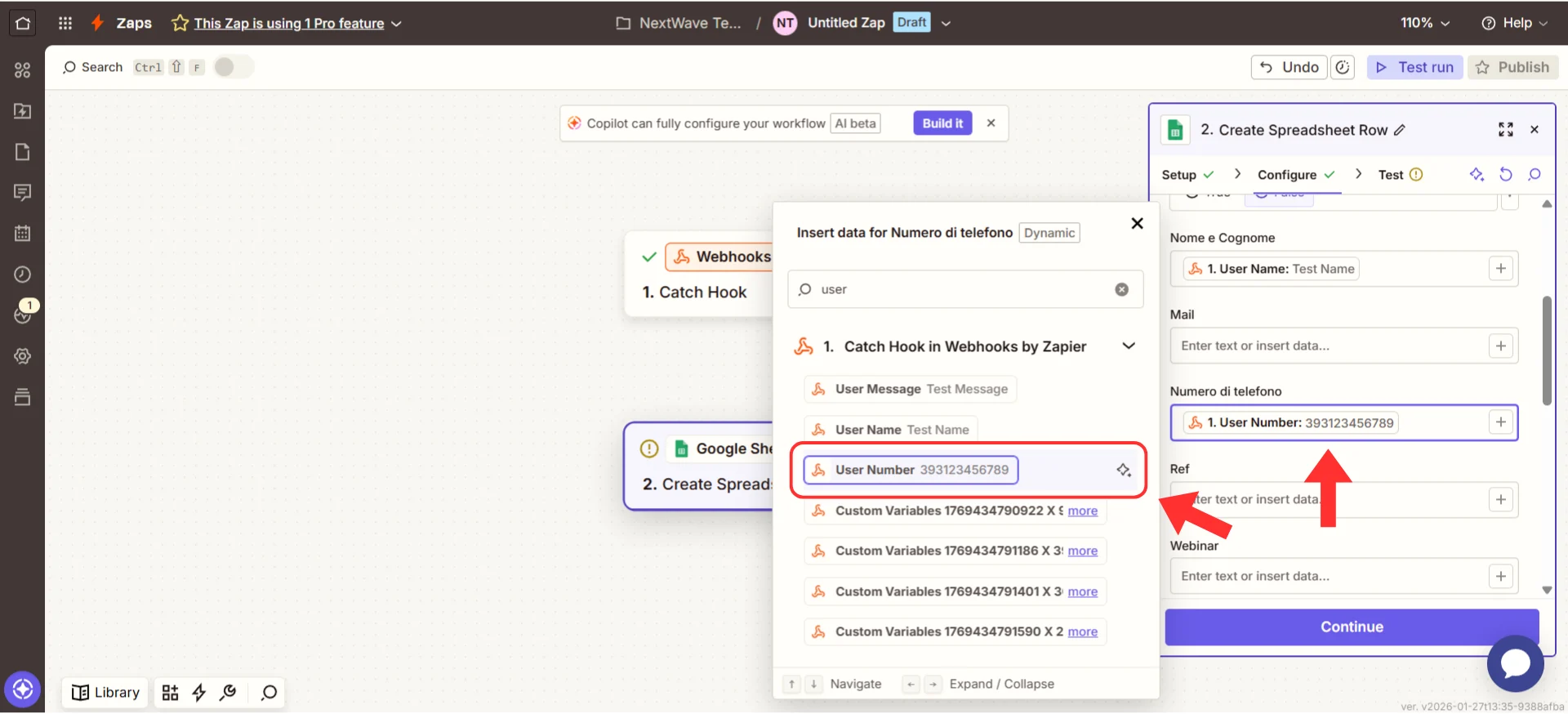
Map Irelia data fields to spreadsheet columns
- Click the “Continue” button
Example B: Send Slack notifications
Great for team visibility- In the “Action” section, search for “Slack”
- Choose “Send Channel Message”
- Connect your Slack workspace
- Select your “Channel” (e.g., #leads, #sales, #notifications)
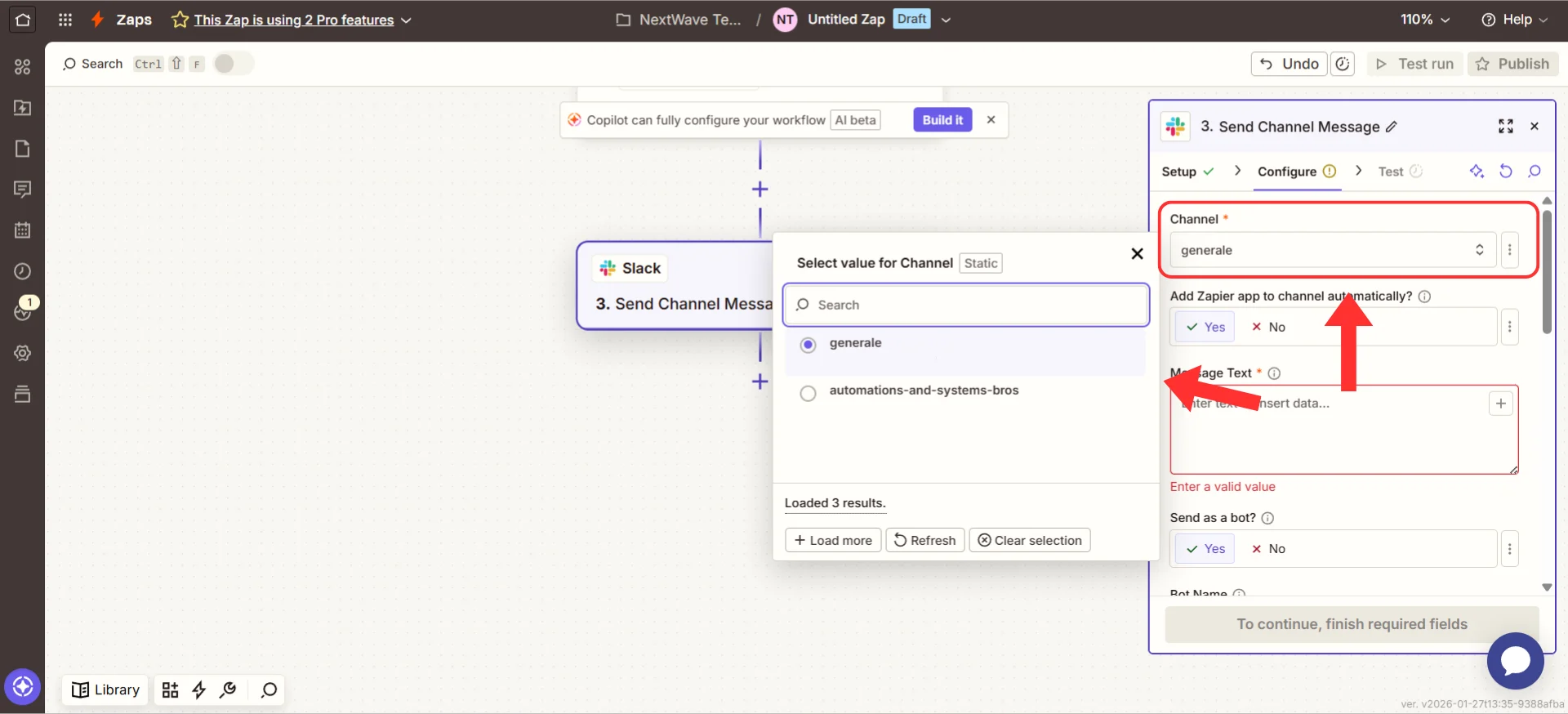
Select the Slack channel for notifications
- Compose your message text using Irelia data fields
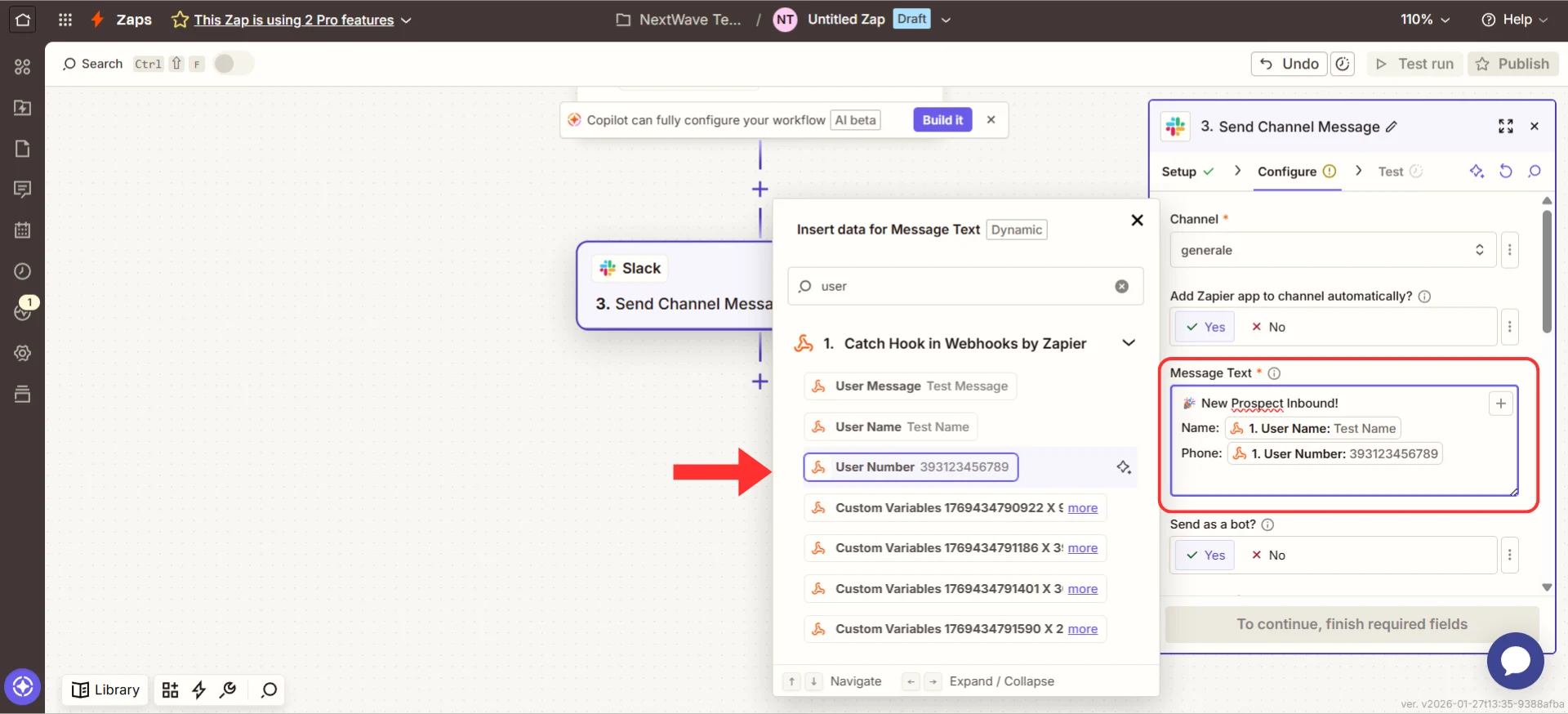
Compose your Slack message using Irelia data fields
- Click the “Continue” button
Example C: Create a CRM contact
Maximum business impact- In the “Action” section, search for your CRM (HubSpot, Salesforce, Pipedrive, etc.)
- Choose “Create Contact” (exact wording varies by CRM)
- Connect your CRM account
- Map Irelia fields to CRM fields
- Click the “Continue” button
Step 5: Test Your Complete Automation
~3 minutes Let’s test the entire workflow end-to-end to make sure everything works together.Run your test
- At the bottom of your action setup, click the “Test action” button (or “Test & Continue”)
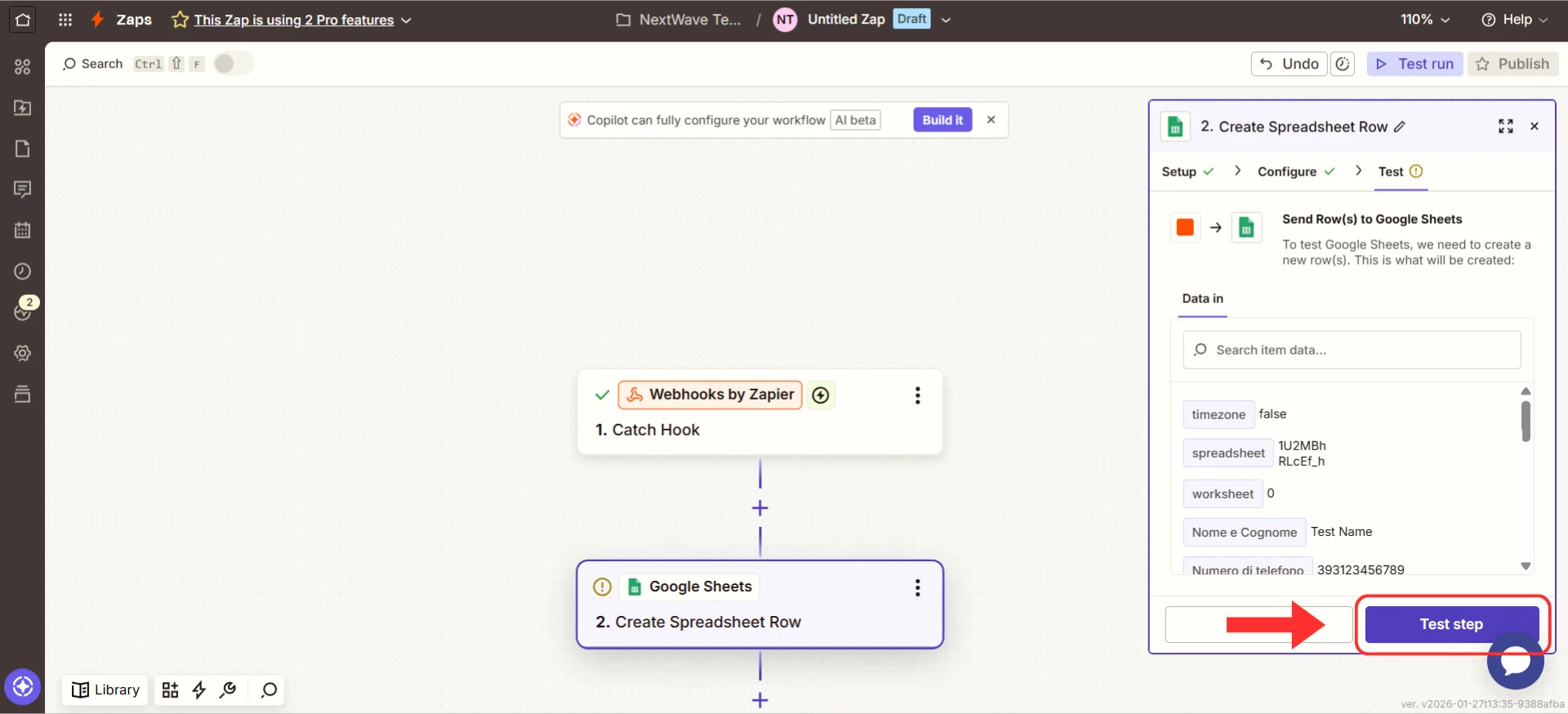
Click Test action to run the complete automation
- Zapier will send your test data to the app you selected
- You’ll see a success message: “Test successful!”
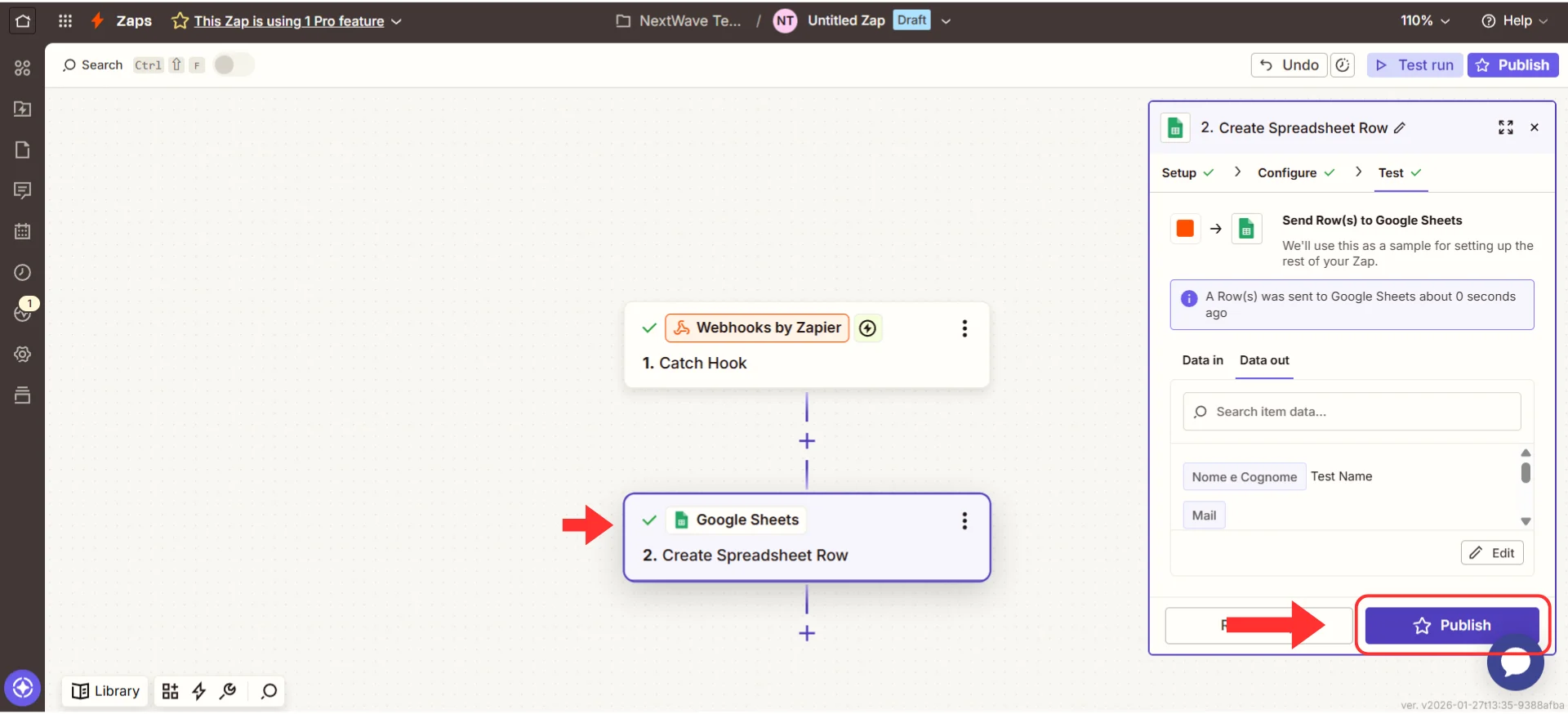
Green success confirmation — your automation pipeline works
Verify it worked
Now check your destination to confirm: If you chose Google Sheets:- Open your spreadsheet
- Look for a new row at the bottom with the test data
- You should see the prospect’s name, phone number, status, etc.
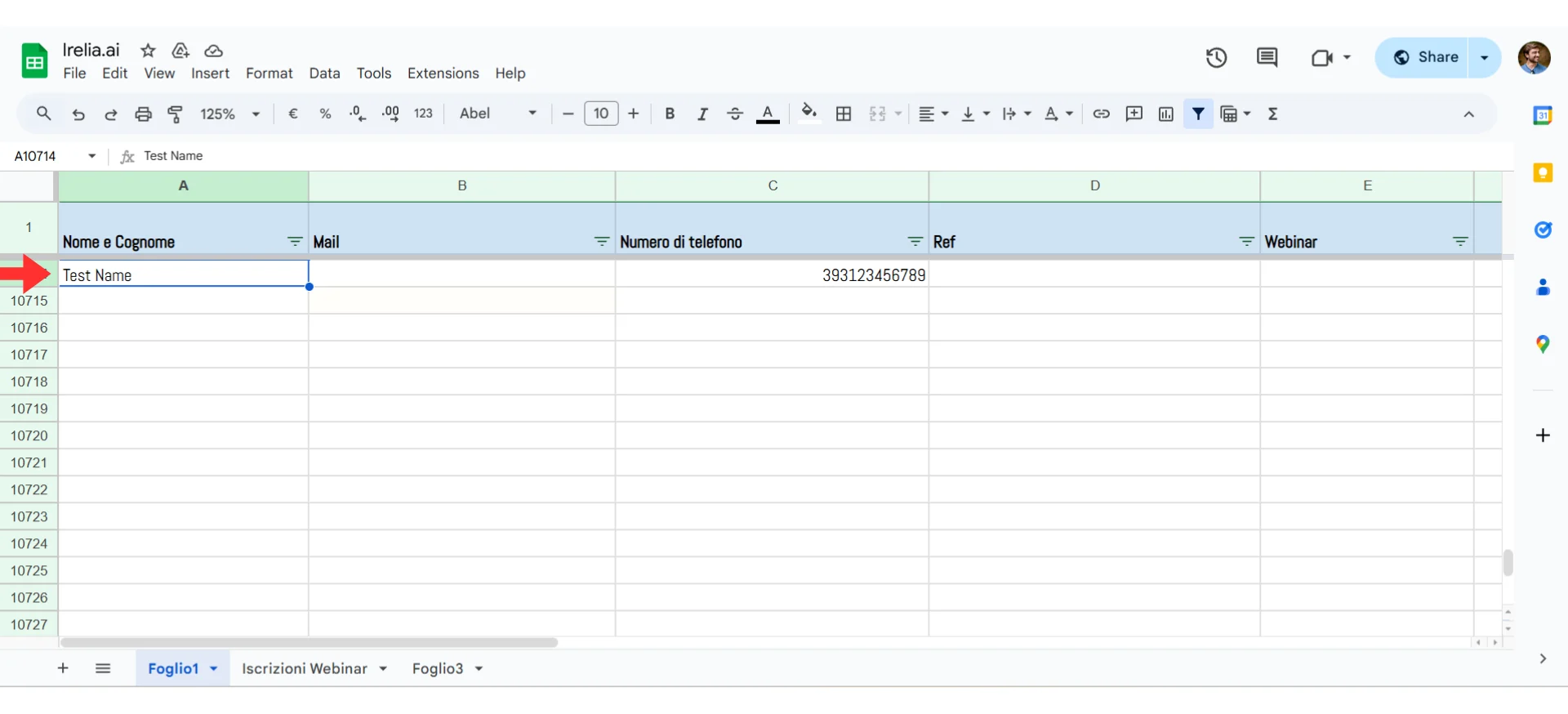
New row with Irelia test data in your spreadsheet
- Open Slack and go to your selected channel
- You should see your formatted message with the test data
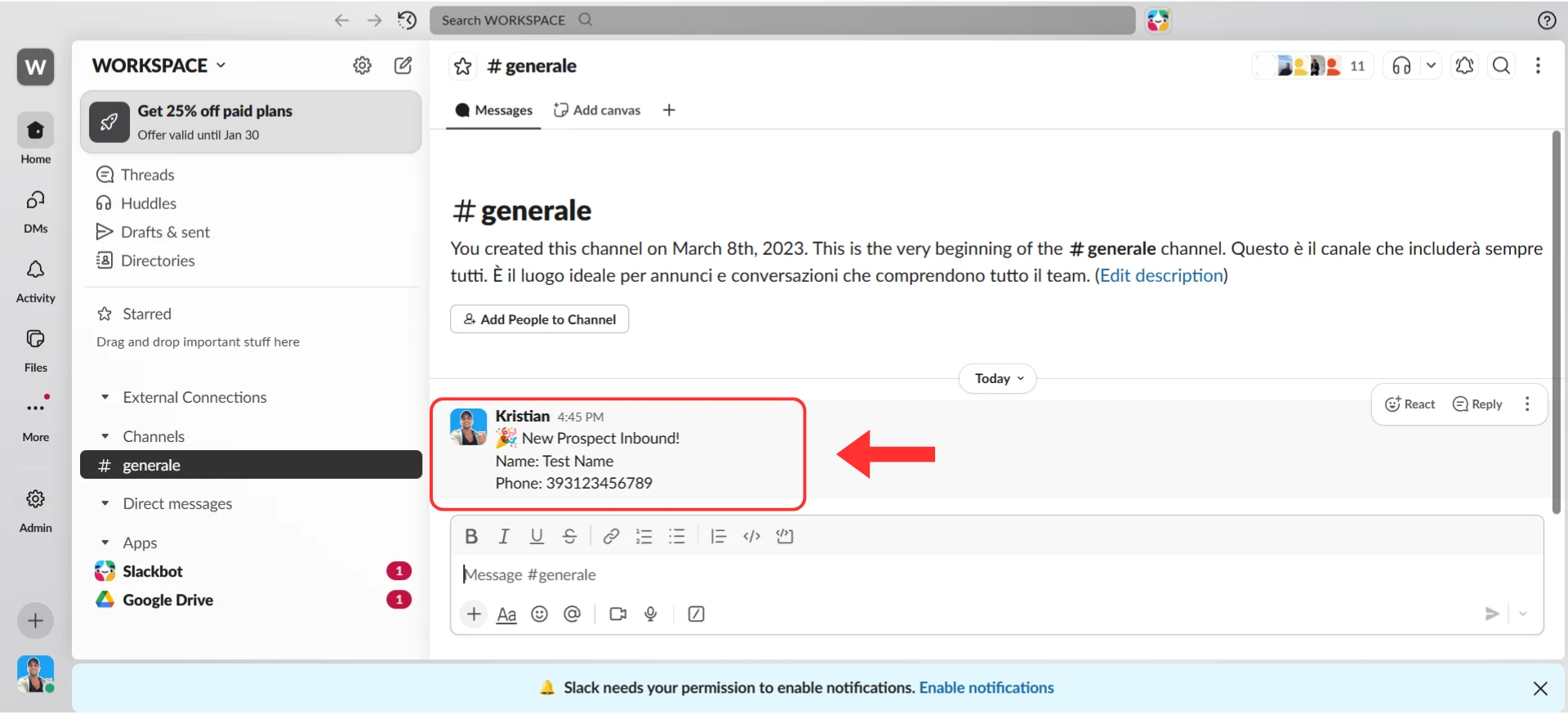
Slack notification with Irelia test data
- Open your CRM and search for the test contact
- Verify the fields are populated correctly
Step 6: Activate and Name Your Zap
~1 minuteActivate your Zap
- At the top of your Zap editor, click the toggle or “Publish” button to turn your Zap ON
- You’ll see a confirmation: “Your Zap is ON”
Give your Zap a name
- Click on the Zap name at the top (it probably says something like “Webhooks by Zapier + Google Sheets”)
- Rename it to something descriptive like:
Irelia: New Contact → Google Sheet
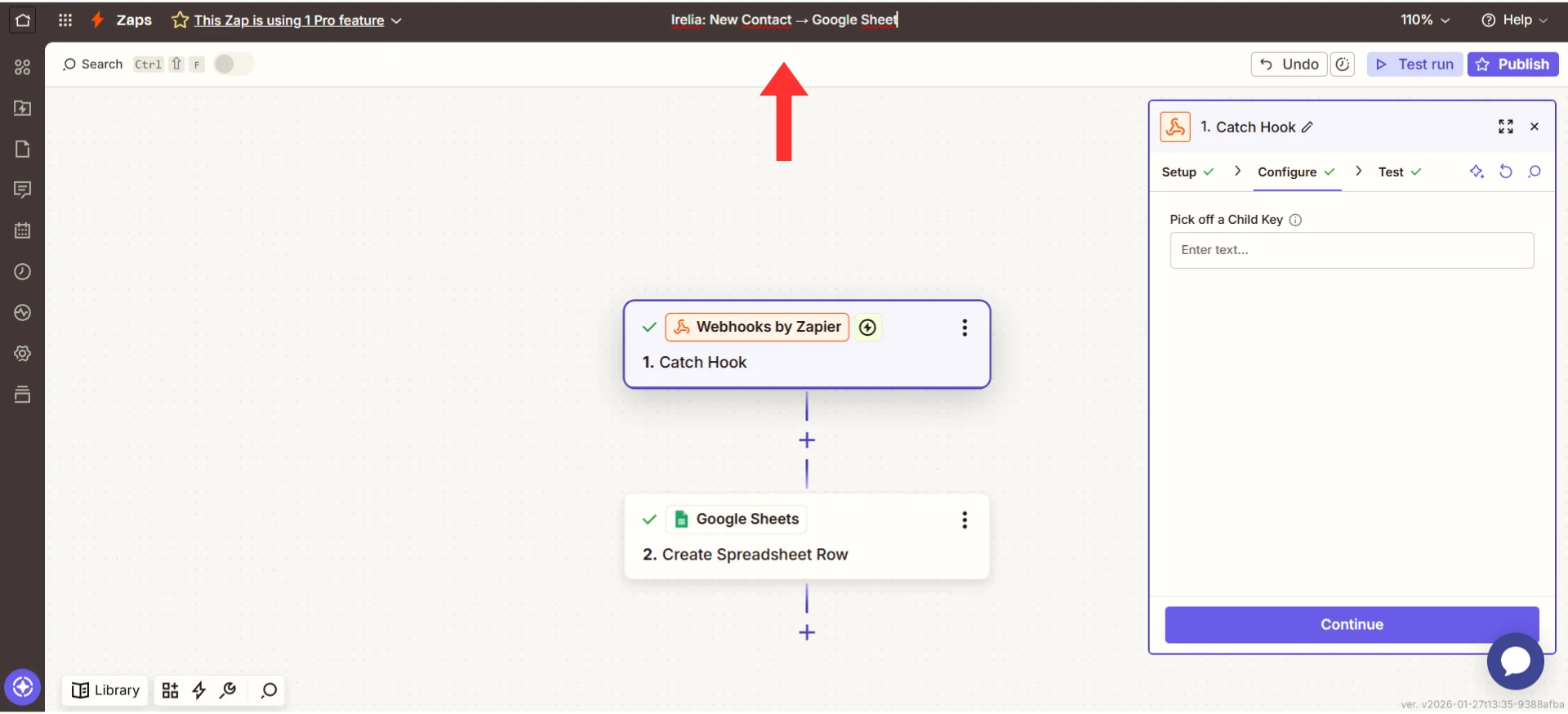
Give your Zap a descriptive name for easy management
🎉 Congratulations! You Did It!
Take a moment to appreciate what you just built: ✅ Your AI agent now talks to your other tools automatically✅ Important moments trigger instant actions
✅ No more manual data entry or checking dashboards — your systems are always up-to-date
✅ Your leads get faster, better follow-up What happens now: Every time someone reaches out to your Irelia agent for the first time → Irelia automatically sends their information to Zapier → Zapier immediately performs your action → All without you lifting a finger. Quick tips for success:
- 🎯 Start simple — One event, one action. Master that before expanding.
- 🧪 Test thoroughly — Always verify with real data before relying on automation.
- 📊 Monitor regularly — Check Zap History weekly, especially at first.
- 🔄 Iterate — Your first automation doesn’t have to be perfect. Refine over time.
- 🤝 Ask for help — Both Irelia and Zapier have great support teams.
Monitoring Your Automation
First few days: Check daily to ensure your Zaps run successfully and your data looks correct. Ongoing: Zapier sends you email notifications when Zaps error out, so you don’t need to check constantly. Just verify things are working during the first few days.Check your Zap History
- Go to “Zap History” (found in the left sidebar of your Zapier dashboard)
- Here you can see every time your Zap runs:
- ✅ Success (green checkmark)
- ❌ Error (red X with details)
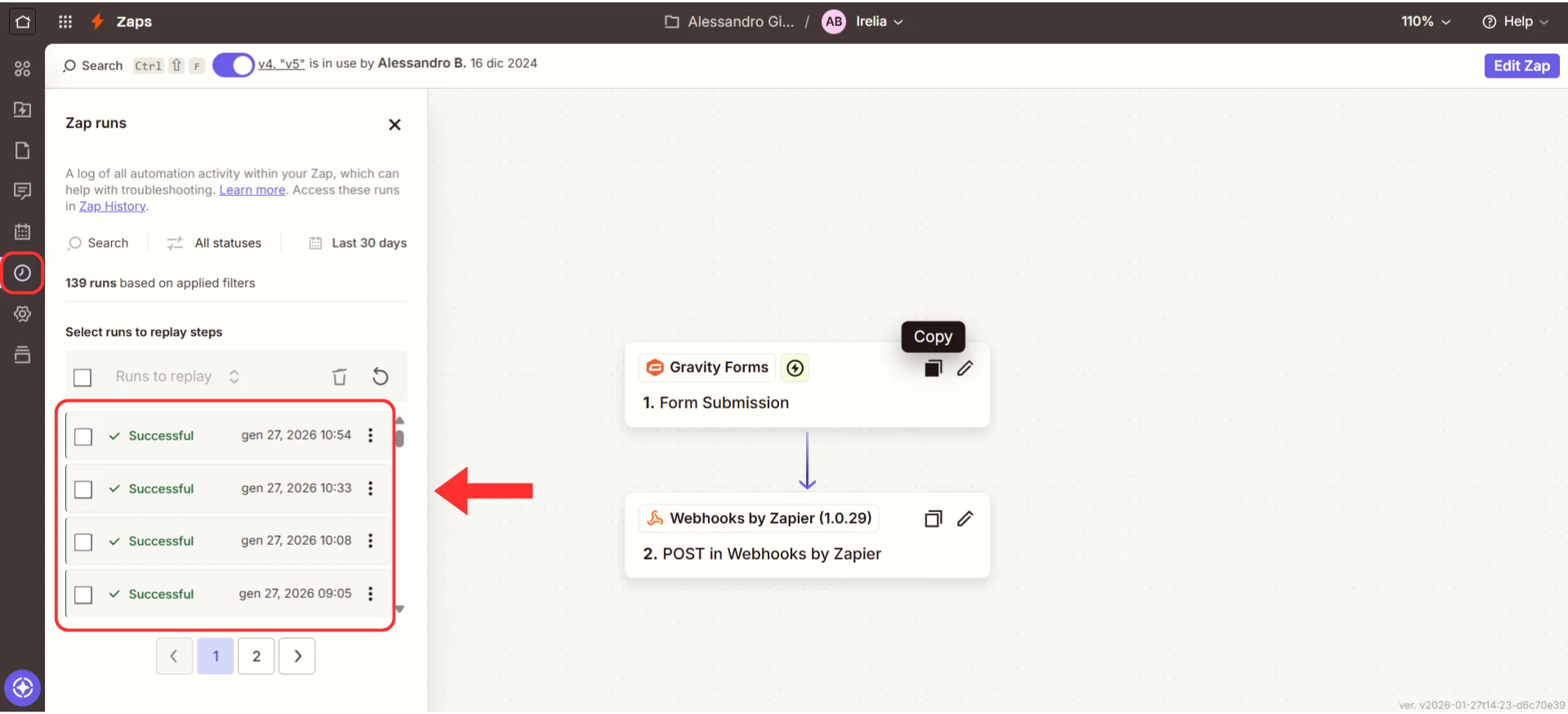
Zap History showing successful runs with green checkmarks
What’s Next?
Now that you have one working automation, the possibilities are endless. If you want to connect to more events like “Data Gathered,” “Lead Qualified,” or “Goal Achieved,” simply repeat the steps above and customize the action (Step 4) to achieve your desired result. Your options from here:- 🎯 Want to track another event? Create a new Zap and repeat this guide — just select a different event in Step 2
- ➕ Want this Zap to do more things? Edit your Zap and click the + button below your action to add more actions
- 🤖 Have another agent to connect? Repeat this guide for your other agents — each can have its own automations
- ⚡ Ready for advanced workflows? Check out the Advanced Automations section below
🚀 Advanced Automations
Ready to do more? These sections show you how to build sophisticated workflows.Search and Update Existing Records
Sometimes you don’t want to create a new record — you want to update an existing one. For example, when a lead you already added gets qualified, or when new data is gathered for someone already in your system. This requires a two-step approach: search first, then update. Example: Update an existing lead’s row when they get qualified. Trigger: Lead Qualified Actions:-
Search for the existing row
- Add action: “Google Sheets” → “Lookup Spreadsheet Row”
- Set “Lookup Column” to “Phone”
- Set “Lookup Value” to
userNumberfrom Irelia - This finds the row matching the prospect’s phone number
-
Update that row with new data
- Add action: “Google Sheets” → “Update Spreadsheet Row”
- Set “Row” to the row number returned from the search action
- Map the fields you want to update (lead status, interest score, etc.)
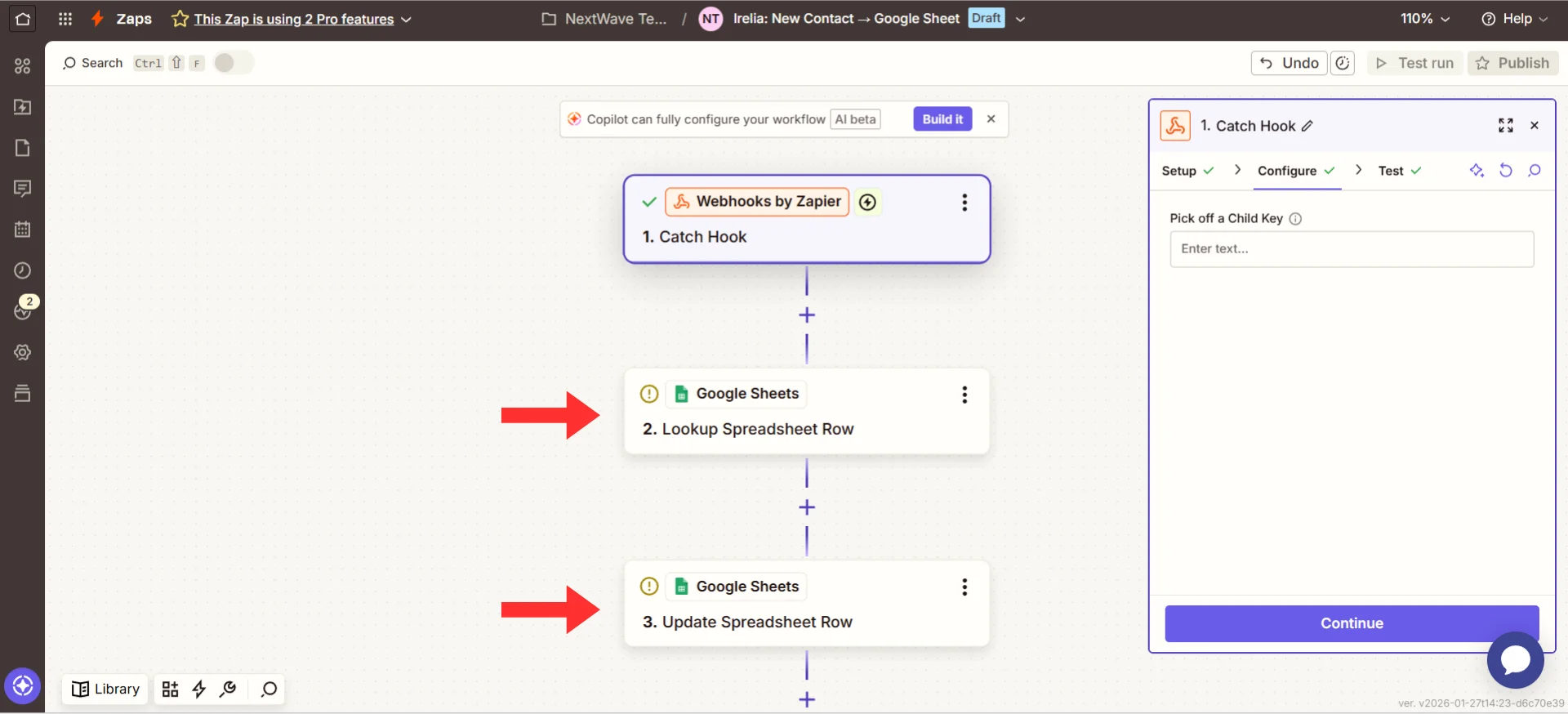
Three-step Zap: Webhook trigger, Lookup Row, Update Row
Using Filters to Control When Actions Run
Filters let you add conditions so your action doesn’t run for every event. Example: Only add to CRM if the prospect’s budget is “$10k-50k” or higher.- In your Zap, click the + button between the trigger and action
- Select “Filter”
- Set your condition:
customVariables Value(text) contains$10k - Only leads meeting this criteria will continue to your action
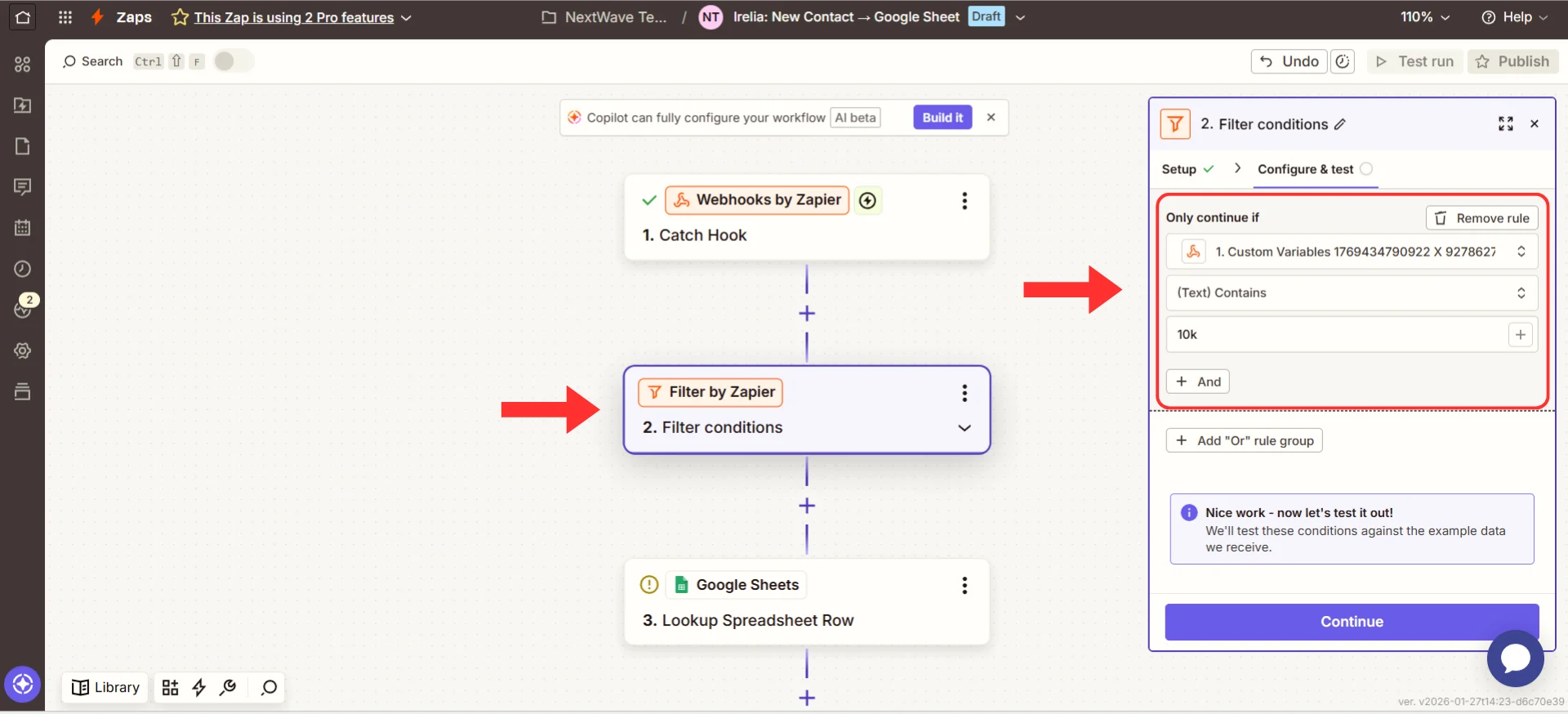
Filter configuration on customVariables Value field
- Only add to CRM if budget matches your target →
customVariables Valueequals$10k-50k - Only notify team if company size is “Enterprise” →
customVariables ValuecontainsEnterprise - Only send to sales if lead is qualified →
leadQualificationequals"fit"
Multi-Step Zaps
Why do one thing when you can do several? Example: When a lead is qualified:- Add to HubSpot CRM
- Send Slack notification to sales team
- Add to “Hot Leads” Google Sheet
- Send welcome email
- After your first action, click the + button below it
- Select “Action”
- Add your second app and configure it
- Repeat for additional actions
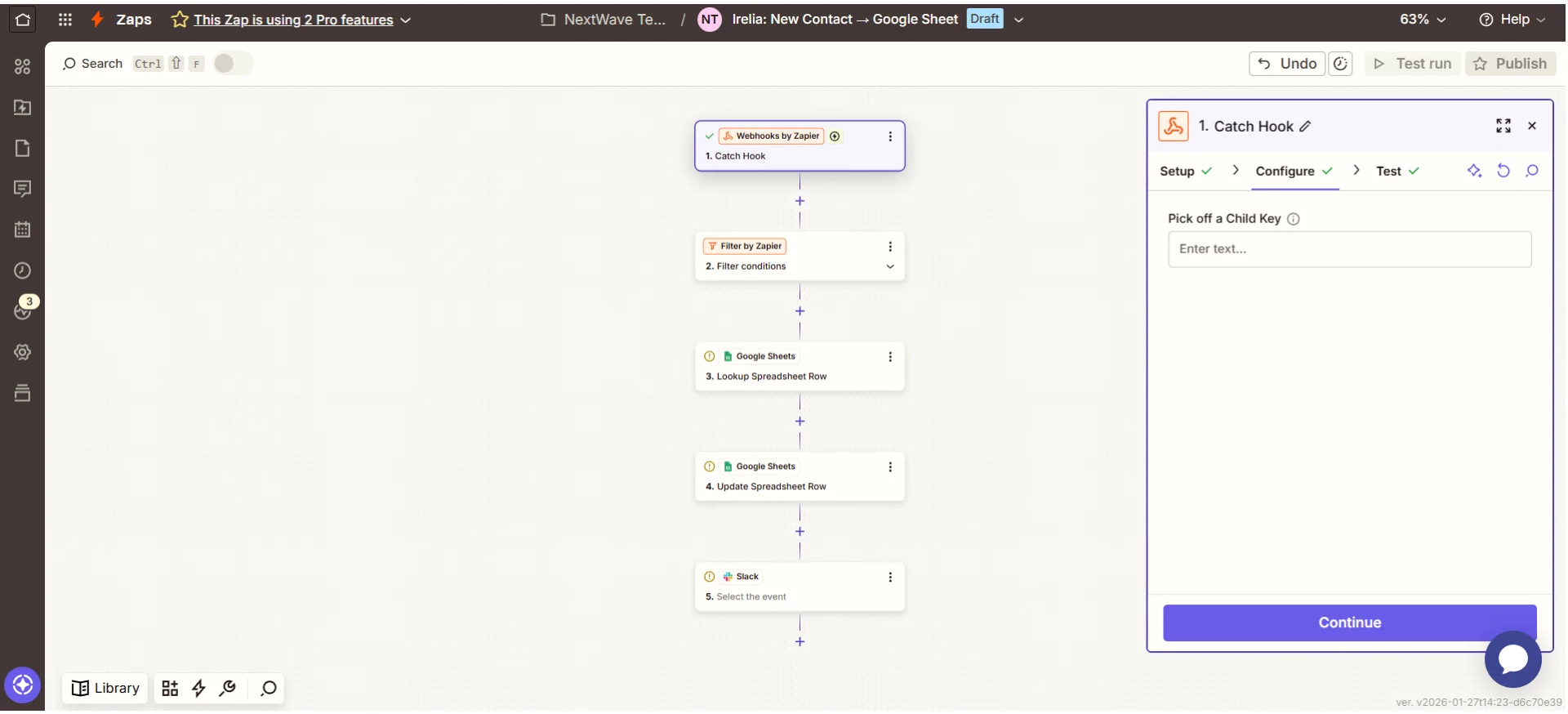
Multi-step Zap with multiple actions from a single webhook trigger
Using Paths for If/Then Logic
Paths let you create branching logic based on data. Example: Route leads based on qualification status:- If
leadQualificationequals"fit"→ Path A: Add to HubSpot + Notify sales - Else If
leadQualificationequals"not a fit"→ Path B: Add to nurture campaign - Else (
"TBD") → Path C: Add to “Needs Review” spreadsheet
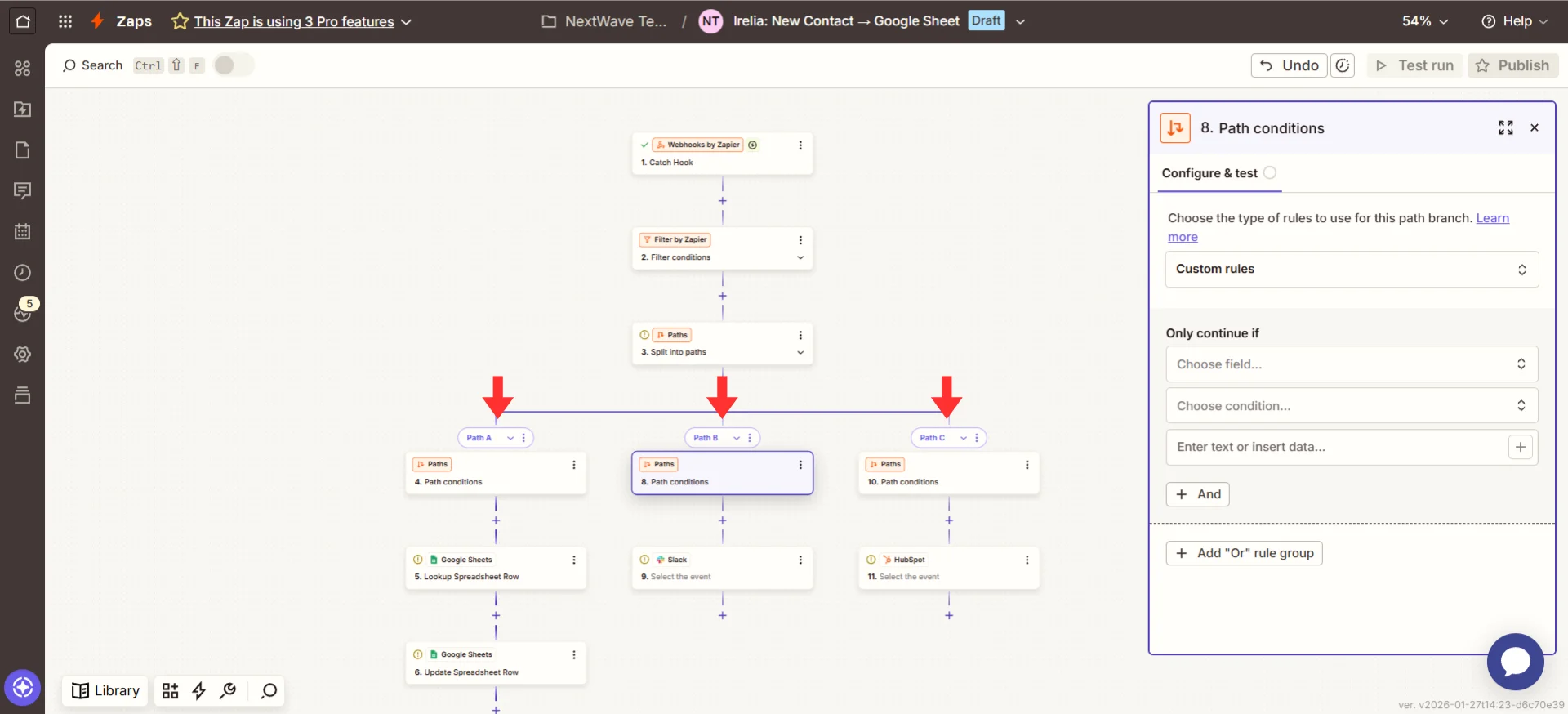
Zapier Paths branching on leadQualification status
Using Formatter for Data Transformation
Zapier’s Formatter tool lets you transform data before sending it:- Format phone numbers consistently (add country code)
- Split
userNameinto first name and last name - Convert
interestScorefrom decimal (0.85) to percentage (85%) - Change date formats to match your CRM
Real-World Use Case Examples
Use case 1: Qualified lead fast track
Trigger: Lead Qualified Actions:- Create contact in HubSpot with “Hot Lead” status
- Send Slack notification to sales team
- Add to “Qualified Leads” Google Sheet
- Send welcome email via Gmail
Use case 2: Disqualified lead nurture
Trigger: Lead Disqualified Actions:- Add to Mailchimp nurture campaign
- Log in “Nurture Pipeline” spreadsheet
- Create task in Asana to follow up in 3 months
Use case 3: Knowledge gap tracking
Trigger: Question Lacking Answer Actions:- Send Slack notification to content team so they can reply manually through the Irelia dashboard
- Log in “Knowledge Base Gaps” spreadsheet
Use case 4: Goal achievement flow
Trigger: Goal Achieved Actions:- Send confirmation email with next steps
- Update CRM with goal completion
- Notify account manager in Slack
Use case 5: Rich data capture
Trigger: Data Gathered Actions:- Update CRM with custom variables (budget, timeline, company size)
- Add to segment-specific sheet (Enterprise vs SMB)
- Trigger personalized email based on answers
✅ Quick Checklist
Use this to verify your setup is complete:Essential Setup
Essential Setup
- Webhook URL copied from Zapier
- URL pasted into Irelia for your chosen event
- Test data sent from Irelia
- Test data received in Zapier
- Action configured (Google Sheets, Slack, or CRM)
- Action tested successfully
- Zap turned ON
- Zap given a descriptive name
Verification
Verification
- Triggered a real event (or used the “Test” button)
- Confirmed data appeared in destination app
- Checked Zap History shows successful run
🛠️ Troubleshooting & FAQs
Don’t panic! Here are the most common issues and exactly how to fix them.Zapier hasn't received any data from Irelia yet
Zapier hasn't received any data from Irelia yet
- Go to Irelia → “Events and Notifications”
- Check that the webhook URL is filled in for your event
- Make sure it matches the URL from Zapier exactly (no extra spaces)
- Click the blue “Test” button in Irelia next to your webhook URL
- Wait 5–10 seconds
- Go back to Zapier and click the “Test trigger” button again
- If still not working, edit your Zap trigger and copy a new webhook URL
- Delete the old URL in Irelia and paste the new one
- Click “Test” again in Irelia
Irelia is sending data correctly, but something's wrong with your action setup
Irelia is sending data correctly, but something's wrong with your action setup
- Zapier shows detailed error messages in red
- Look for phrases like “Required field missing” or “Authentication failed”
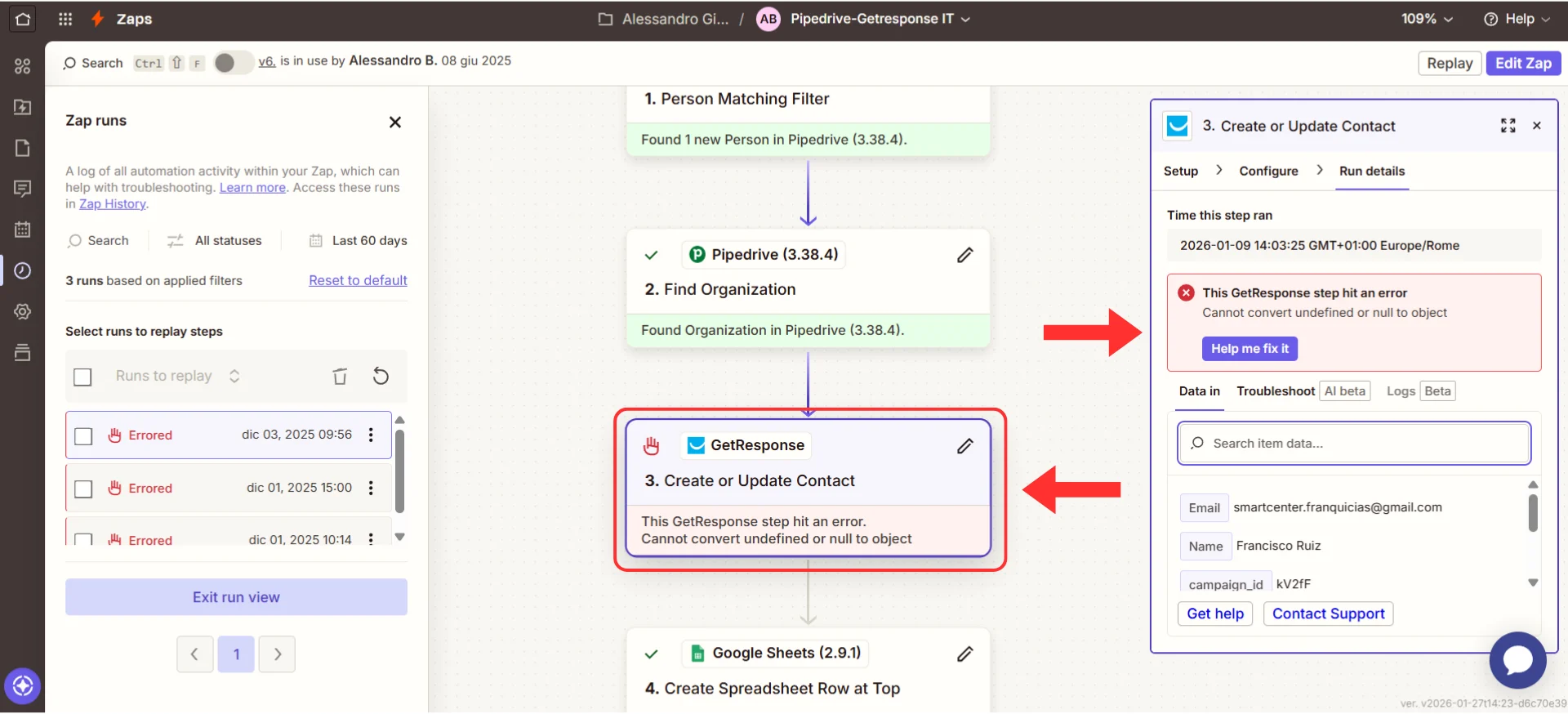
Zapier error message with diagnostic details
- Look for fields marked with a red asterisk (*)
- Make sure each required field has data mapped
- In your action setup, click “Reconnect” or the account name
- Sign in again and grant permissions
- Test the action again
- Google Sheets: Confirm the spreadsheet wasn’t deleted
- Slack: Check the channel wasn’t archived
- CRM: Verify pipeline/status values still exist
The Zap says it succeeded, but you can't find the data
The Zap says it succeeded, but you can't find the data
- Go to Zapier → “Zap History”
- Click on your recent run to expand details
- Look at “Data Out” to see exactly what was sent
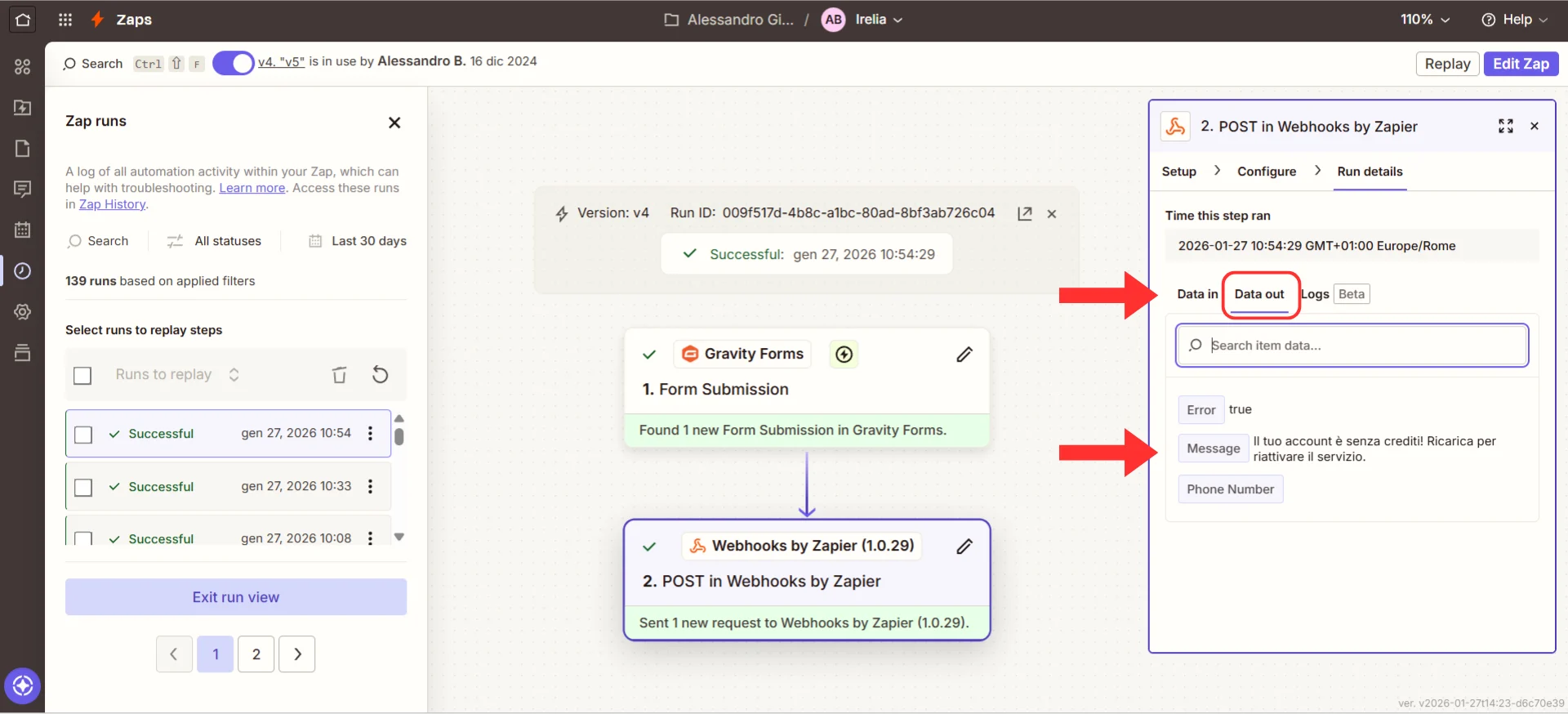
Expanded Zap History run showing Data Out details
- Google Sheets: Scroll to the bottom (new rows are added at the end). Try Ctrl+F to search.
- Slack: Check you’re in the right channel. Search for messages from “Zapier.”
- CRM: Search by phone number instead of name. Check if you’re in a filtered view.
- Go back to your Zap editor
- Look for any Filter steps between trigger and action
- Verify your data passes the filter conditions
Your automation worked during testing but stopped working for real events
Your automation worked during testing but stopped working for real events
- Go to your Zapier dashboard
- Verify your Zap shows “ON” in green
- If it says “OFF” or “Paused”, turn it back on
- Edit your Zap and look for yellow warning icons
- Reconnect any apps that show warnings
- This is especially common with Google accounts
- Go to Irelia → “Events and Notifications”
- Confirm the webhook URL is still there
- Go to “Account” → “Usage”
- Free plans have 100 tasks per month
- If you’ve hit the limit, upgrade or wait for the reset
The same contact is being processed multiple times
The same contact is being processed multiple times
- Check all your active Zaps
- Look for duplicates with the same trigger
- Turn off or delete duplicate Zaps
- Verify each event has a unique webhook URL
- If you pasted the same URL in multiple events, that’s the problem
The customVariables field is empty or doesn't have the expected data
The customVariables field is empty or doesn't have the expected data
- “New Inbound Contact” fires before data collection
- Use “Data Gathered,” “Goal Achieved,” or “Lead Qualified” events instead if you need collected data
- Custom variables are numbered in the Zapier interface
- Make sure you’re mapping the correct index for each variable
- Instead of using the “Test” button, have a full conversation that reaches data collection
- Then check if data flows through
🆘 Need Help?
- Contact support in the WhatsApp priority support group or send an email to info@irelia.ai
- Include: screenshots of your configuration, the error message, and what you expected vs. what happened
- Visit: help.zapier.com
- Check: status.zapier.com for outages